- Have any Query
- (303) 807-1061
- doug@servohydraulicsolutions.com
Servo-Hydraulic vs Electrodynamic & Motorized Shake Tables: Which Vibration Table Fits High-Payload Testing?

Earthquake Simulation Shake Table Cost & Pricing Factors: Teaching Platforms vs Custom Servo-Hydraulic Systems
November 12, 2026
Large Hydraulic Shaker Table Procurement Guide: Sizing Overturning Moment, Reaction Mass & Actuator Force
November 12, 2026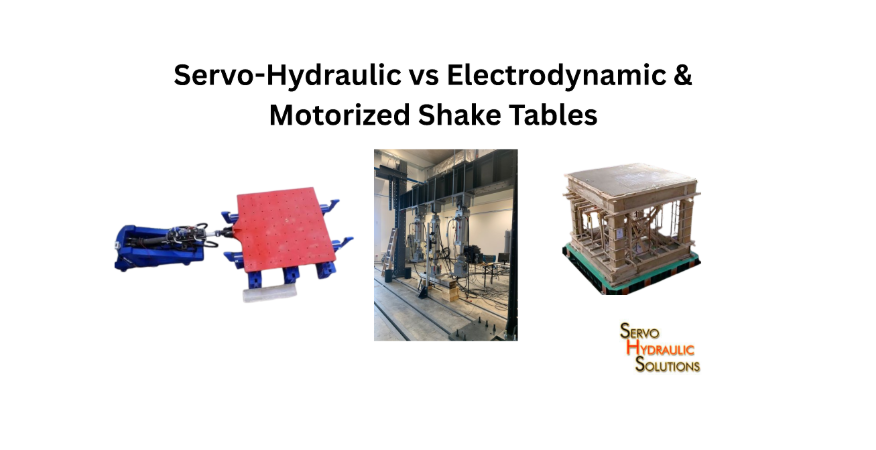
Earthquake simulation shake table prices range from 653–3,000 for small open-source educational stepper platforms and 15,000–45,000 for entry-level commercial units, while custom high-payload servo-hydraulic shake tables typically require custom engineering quotes starting from tens of thousands to several hundred thousand dollars depending on payload, axes (uniaxial vs. multi-DOF), and Hydraulic Power Supply (HPU) capacity. Choosing an open-architecture COTS servo-hydraulic system allows university and commercial labs to match real seismic velocity and force requirements without paying proprietary OEM markups.
For high-payload vibration testing, a servo-hydraulic shaker table is often the strongest choice when specimens are heavy, require substantial force, or need large displacement at relatively low frequencies. Electrodynamic shakers are generally better suited to higher-frequency testing and precise vibration control, while motorized shake tables work well for defined motion profiles and simpler testing requirements. The right choice depends on the specimen’s total moving mass, required acceleration, frequency, stroke, and test objectives—not payload alone.
What Is a High-Payload Vibration Table?
A high-payload vibration table is a testing platform designed to move heavy specimens through controlled vibration or motion profiles. It is used to evaluate how structures, components, machinery, and equipment respond to dynamic loads.
Examples include testing industrial equipment, electrical cabinets, structural components, vehicle assemblies, and large mechanical systems. These specimens can be difficult to test because their weight, dimensions, mounting arrangements, and centre of gravity all affect the vibration system.
A common mistake is to compare vibration tables using only their advertised maximum payload. A table rated for a particular mass may not achieve the required acceleration or frequency when carrying that mass.
Why Payload Alone Does Not Define Capability
Payload tells you how much mass a system can support or move under specified conditions. It does not automatically tell you how effectively the table can reproduce a vibration profile.
Two systems with similar payload ratings may perform very differently because of differences in actuator force, stroke, velocity, frequency response, and control capability.
For example, a table might physically support a 500 kg specimen but struggle to reproduce the required acceleration at a particular frequency. Another system may handle the same mass more comfortably because it has greater force capacity and a suitable mechanical design.
Always review the full performance specifications rather than choosing a system based only on its maximum load rating.
Specimen, Fixture, and Moving Mass
The total moving mass includes more than the specimen being tested. It may include:
- The test specimen and its attached components.
- Mounting fixtures and adapter plates.
- Slip tables or additional moving assemblies.
- Sensors and other equipment that move with the specimen.
- Any additional moving structure included in the test configuration.
Consider a 400 kg industrial cabinet. If its mounting fixture weighs another 100 kg, the vibration system must account for at least 500 kg of moving mass, excluding any additional moving components not already included in the manufacturer’s rating.
This distinction matters when selecting a high payload vibration testing table. Ignoring fixture weight can lead to incorrect force calculations and unrealistic performance expectations.
Force, Stroke, Velocity, and Frequency Limits
Four specifications deserve particular attention:
- Force: Determines the system’s ability to accelerate the moving mass.
- Stroke: Defines the moving platform’s available displacement.
- Velocity: Limits how quickly the platform can move.
- Frequency: Defines the range of vibration frequencies the system can reproduce.
These specifications are connected. A system may provide high force but have limited displacement, or offer a large stroke while operating within a restricted frequency range.
Your test profile must fit within all the relevant limits at the same time.
Servo-Hydraulic Shake Tables Explained
Servo-hydraulic shake tables use pressurized hydraulic fluid and controlled actuators to generate mechanical movement. They are commonly selected for large specimens, demanding structural tests, and applications that require substantial force or displacement.
For heavy specimens, hydraulic systems offer an important advantage: they can deliver high force without relying on an extremely large electromagnetic shaker assembly.
Beyond dedicated seismic tables, facilities often integrate multi-axis servo-hydraulic testing machines to conduct component-level fatigue, tension-compression, and structural fracture mechanics research.
How a Servo-Hydraulic Shaker Table Works
A typical servo-hydraulic system includes a hydraulic power unit (HPU), servo valves, hydraulic actuators, sensors, and a digital controller.
The HPU supplies pressurized fluid to the actuators. The servo valve regulates fluid flow and direction to control actuator movement. The controller compares the requested motion with sensor feedback and adjusts the valve commands to reproduce the required test profile.
The basic process is:
- The operator defines the required vibration or motion profile.
- The controller sends commands to the servo valves.
- Hydraulic pressure drives the actuators.
- Sensors measure the actual movement and system response.
- The controller continuously adjusts the output to follow the target profile.
This closed-loop arrangement is important when testing heavy or complex specimens. It helps the system reproduce the required movement while accounting for changes in load and dynamic response.
Payload and Force Capability
Servo-hydraulic systems are particularly useful when the specimen requires substantial driving force. They can be designed around large payloads, high actuator forces, and demanding structural testing conditions.
Their capacity depends on several factors:
- Number and size of hydraulic actuators.
- Available hydraulic pressure and flow.
- Mechanical platform design.
- Specimen and fixture mass.
- Required acceleration and motion profile.
- Structural stiffness and system configuration.
A large payload does not mean every test can run at the maximum rated acceleration. The available force must be sufficient for the combined moving mass under the actual test conditions.
Stroke and Low-Frequency Performance
One of the main reasons to select a hydraulic vibration table is its ability to provide relatively large displacement and strong low-frequency performance.
This is valuable in earthquake simulation and structural testing, where realistic ground-motion profiles may involve significant displacement at relatively low frequencies.
For example, a laboratory testing a large structural assembly may need to reproduce slow, substantial movements rather than only rapid, small-amplitude vibration. A properly designed servo-hydraulic system is often better suited to this requirement than a conventional electrodynamic shaker.
Best Applications for Servo-Hydraulic Systems
Servo-hydraulic shake tables are commonly considered for:
- Earthquake simulation and structural testing.
- Heavy industrial equipment qualification.
- Large electrical cabinets and equipment assemblies.
- Seismic testing of machinery and support structures.
- Large-scale component and subsystem testing.
- Low-frequency, high-force vibration applications.
They are especially suitable when the specimen’s mass, required stroke, and force demand make smaller vibration systems impractical.
Electrodynamic Shakers Explained
Electrodynamic shakers use electromagnetic force to produce controlled vibration. They are widely used in product development, electronics testing, component qualification, and environmental vibration testing.
Compared with large hydraulic systems, electrodynamic shakers are often easier to integrate into laboratories where precise vibration control and higher-frequency performance are priorities.
How an Electrodynamic Shaker Works
An electrodynamic shaker operates using the interaction between a magnetic field and electrical current in a moving coil.
The coil is connected to the moving element, which transfers vibration to the specimen through the shaker armature or an appropriate fixture. A power amplifier supplies the required electrical signal, while a controller and sensors regulate the vibration.
The system typically includes:
- Shaker body and armature.
- Magnetic assembly.
- Power amplifier.
- Vibration controller.
- Accelerometers and feedback sensors.
- Mounting fixtures or slip tables, where required.
The controller adjusts the electrical input to reproduce the desired vibration profile.
Payload and Force Limits
Electrodynamic shakers are available in different force ratings, from small laboratory units to powerful systems used for demanding industrial and aerospace testing.
However, their usable payload depends on the force rating and required acceleration. Adding specimen mass increases the force needed to achieve the same acceleration.
For this reason, a shaker that performs well with a small electronic component may not suit a heavy equipment assembly.
Electrodynamic systems are designed for substantial loads, so it would be incorrect to assume every electrodynamic shaker is limited to lightweight specimens. The actual force, displacement, and frequency specifications must be checked.
Frequency Range and Displacement Limits
Electrodynamic systems are generally attractive for applications requiring a broad frequency range, accurate vibration reproduction, and relatively small displacement.
They are frequently used for:
- Electronics and circuit board testing.
- Automotive component testing.
- Aerospace component qualification.
- Resonance searches.
- Random vibration testing.
- Product durability and reliability testing.
Their main limitation in heavy, large-displacement applications is often the combination of available force, armature displacement, and moving mass. A high-force shaker may still be unsuitable if the required stroke exceeds its operating limits.
Best Applications for Electrodynamic Systems
Choose an electrodynamic shaker when the testing programme involves controlled vibration over a wide frequency range, relatively small displacement, and a specimen mass within the system’s rated capacity.
For example, testing the vibration response of an electronic control unit or a compact mechanical assembly often fits an electrodynamic system better than a large servo-hydraulic table.
Motorized Shake Tables Explained
Motorized shake tables use electric motors and mechanical drive arrangements to produce controlled movement. Depending on the design, they may use lead screws, ball screws, belts, gears, or crank mechanisms.
These systems are often used for educational demonstrations, basic vibration studies, repetitive movement, and applications with clearly defined motion requirements.
How Motorized Vibration Tables Work
An electric motor drives a mechanical transmission that moves the platform. A controller regulates motor speed, direction, and movement according to the programmed profile.
Some systems provide simple linear or reciprocating movement, while more advanced designs can reproduce selected motion patterns.
Their performance depends heavily on the drive mechanism, motor capacity, mechanical stiffness, control system, and platform design.
Payload and Motion Limits
Motorized tables can support different loads depending on their construction. However, supporting a heavy object is not the same as dynamically moving it through a demanding vibration profile.
Important limitations may include:
- Motor torque and power.
- Mechanical transmission capacity.
- Backlash and mechanical compliance.
- Maximum speed and acceleration.
- Available travel or stroke.
- Heat generation during continuous operation.
A motorised platform may suit a repeatable movement test but not high-force seismic simulation.
When Motorized Systems Are Suitable
Motorized systems are useful when the test requires controlled movement rather than complex, high-performance vibration reproduction.
Typical applications include:
- Classroom vibration demonstrations.
- Basic mechanical movement studies.
- Repetitive positioning tests.
- Low-speed reciprocating motion.
- Small-scale prototype testing.
- Simple transport or handling simulations.
The key is to match the drive system to the required movement. Don’t select a motorised table for a demanding vibration test just because its platform looks large enough.
Motorized vs Servo-Hydraulic Systems
The biggest difference is how the movement is generated and controlled.
A motorized system uses an electric motor and mechanical transmission. A servo-hydraulic system uses pressurised fluid and servo-controlled actuators.
Motorized tables can be economical and straightforward for defined motion profiles. Servo-hydraulic systems are generally more appropriate when high force, large stroke, heavy moving mass, or demanding dynamic performance is required.
Servo-Hydraulic vs Electrodynamic Shakers
Both technologies can deliver controlled vibration, but they are designed around different performance priorities. The right choice depends on the actual test profile, not the technology’s general reputation.
Force and Payload Comparison
| Parameter | Servo-hydraulic | Electrodynamic |
| Heavy moving mass | Well suited when correctly designed | Depends on available force and shaker rating |
| Force generation | Hydraulic actuators | Electromagnetic drive |
| High-force applications | Common choice | Available in high-force configurations |
| Small specimens | Can be used, but may be excessive | Often a practical choice |
| Large structural specimens | Commonly suitable | Depends on system capacity and configuration |
For a heavy specimen, calculate the required force before comparing equipment. A payload rating without its associated acceleration and frequency conditions does not provide enough information.
Stroke and Low-Frequency Capability
Servo-hydraulic systems are often preferred for applications involving substantial stroke and low-frequency motion. This makes them useful for earthquake simulation, structural testing, and large equipment qualification.
Electrodynamic shakers are generally preferred when the test needs smaller displacement and higher-frequency vibration.
Neither technology should be selected using frequency range alone. Check the available force, displacement, and velocity at the actual operating frequency.
Frequency Range and Control Precision
Electrodynamic shakers are widely used for precise sine, random, and other controlled vibration tests across broad frequency ranges.
Servo-hydraulic systems can also provide accurate closed-loop control, including complex motion profiles. Their suitability depends on actuator dynamics, hydraulic supply performance, controller design, and the specimen’s response.
The important question is whether the system can reproduce the required test profile within the specified tolerances.
Cost, Maintenance, and Facility Needs
Servo-hydraulic systems generally require more supporting infrastructure. This can include hydraulic power units, cooling arrangements, fluid lines, electrical supply, and suitable foundations.
Electrodynamic systems require a power amplifier, cooling provisions where applicable, control hardware, and appropriate mounting arrangements. Smaller configurations may have simpler facility requirements.
Motorized tables may have lower infrastructure requirements, but mechanical components such as screws, bearings, gears, and drive assemblies still need inspection and maintenance.
When comparing quotations, include installation, commissioning, training, utilities, maintenance, and future upgrades—not just the equipment price.
When planning infrastructure for servo-hydraulic test rigs, laboratories must also invest in custom hydraulic power supplies (HPS) designed with proper reservoir baffling, micro-clean filtration, and acoustic dampening to ensure stable 3,000 PSI output.
How to Choose a Shaker for Heavy Specimens
Choosing a shaker for heavy specimens starts with the test requirement. First identify what needs to move, how far it must move, and what acceleration and frequency range the test demands.
Calculate Total Moving Mass
Add the mass of the specimen, fixtures, adapters, and all other components that move with the platform.
For example:
| Component | Example mass |
| Test specimen | 400 kg |
| Mounting fixture | 75 kg |
| Adapter plate | 25 kg |
| Total moving mass | 500 kg |
This is a simplified example, but it illustrates why fixture weight should be included from the beginning.
Also check the manufacturer’s definition of payload. Some specifications refer to specimen capacity, while others include or exclude parts of the moving assembly.
Match Force to Required Acceleration
The basic relationship between force, mass, and acceleration is:
F = m × a
Where:
- F = required force in newtons (N).
- m = total moving mass in kilograms (kg).
- a = required acceleration in metres per second squared (m/s²).
Suppose the moving mass is 500 kg and the required acceleration is 2 m/s².
Required force = 500 × 2 = 1,000 N.
This is an idealised calculation. Actual system sizing must also consider friction, mechanical dynamics, actuator arrangement, fixture behaviour, and the force needed to reproduce the complete test profile.
For multi-axis systems, the force requirement must be assessed in each relevant direction.
Check Stroke, Velocity, and Frequency
A shaker must satisfy all three motion requirements, not just force.
Ask:
- What is the maximum required displacement?
- What is the operating frequency range?
- What peak velocity is required?
- Are the limits specified as peak, peak-to-peak, or RMS values?
- Can the system reproduce the complete profile under the intended load?
For sinusoidal motion, displacement, velocity, and acceleration are related to frequency. As frequency increases, the required velocity and acceleration can rise quickly for the same displacement.
That’s why you should never consider a system’s maximum stroke separately from its frequency and acceleration limits.
Consider Fixture, Slip Table, and Mounting
A suitable shaker can still produce poor test results if the specimen is mounted incorrectly.
Check the fixture’s stiffness, mass, mounting pattern, and load distribution. For horizontal testing, a slip table may be required to transfer motion while supporting the specimen.
Also consider the specimen’s centre of gravity. An off-centre load can create overturning moments and unwanted movement, particularly in large or multi-axis configurations.
Plan for Safety Margins and Future Tests
Do not design the system to operate continuously at its absolute limits. Allow suitable engineering margins based on the test profile, duty cycle, load variation, and manufacturer’s recommendations.
Consider future specimens too. A laboratory expecting heavier equipment or additional test configurations may benefit from a system designed for expansion.
The right margin is not one universal percentage. It should be established through engineering review of the complete system.
Which Vibration Table Fits Your Testing Needs?
The best technology depends on the specimen type and the test profile you need to reproduce.
Choose Servo-Hydraulic for Heavy, Low-Frequency Tests
A servo-hydraulic system is usually the better option when you need:
- High force for heavy moving specimens.
- Large displacement or stroke.
- Low-frequency earthquake simulation.
- Structural and industrial equipment testing.
- Custom multi-axis configurations.
For a large electrical cabinet, structural assembly, or heavy mechanical unit, this technology may provide the force and displacement needed for realistic testing.
Choose Electrodynamic for High-Frequency Testing
An electrodynamic shaker is generally a good choice for:
- Electronics and small mechanical components.
- Higher-frequency vibration testing.
- Sine and random vibration profiles.
- Product qualification and durability studies.
- Applications requiring precise vibration control with manageable moving mass.
It can also test heavier equipment when the selected system has sufficient force and suitable fixtures. The decision should be based on its performance curves, not assumptions about the technology.
Choose Motorized for Defined Transport or Motion Profiles
Motorized tables make sense when the requirement involves repeatable movement, basic vibration demonstrations, or relatively simple motion profiles.
They are not automatically a substitute for servo-hydraulic or electrodynamic systems. If the test requires high acceleration, complex dynamic response, or demanding seismic simulation, check whether the mechanical drive can actually deliver it.
When More Than One System Is Needed
Some laboratories perform different types of testing that one platform cannot handle efficiently.
For example, a structural engineering laboratory may need a servo-hydraulic shake table for large specimens and an electrodynamic shaker for smaller components that require higher-frequency vibration.
Using separate systems can improve testing flexibility and avoid compromising one test requirement to accommodate another.
Frequently Asked Questions
What Is a Servo-Hydraulic Shaker Table?
A servo-hydraulic shaker table uses hydraulic actuators, servo valves, and a feedback controller to generate controlled vibration or movement. It is commonly used for heavy specimens, structural testing, earthquake simulation, and applications requiring high force or substantial stroke.
What Is the Difference Between Servo-Hydraulic and Electrodynamic Shakers?
Servo-hydraulic shakers generate movement using pressurised hydraulic fluid, while electrodynamic shakers use electromagnetic force. Hydraulic systems are often preferred for high-force, large-displacement applications, whereas electrodynamic systems are widely used for precise, higher-frequency vibration testing.
Which Shaker Is Best for Heavy Specimens?
A servo-hydraulic system is often the best starting point for heavy specimens that require high force, large displacement, or low-frequency movement. However, a high-force electrodynamic shaker may also be suitable if its rated performance meets the complete test requirement.
How Much Payload Can a Shake Table Handle?
Payload varies widely by technology, model, and configuration. Small educational tables may handle lightweight specimens, while custom industrial and structural systems can be engineered for much larger moving masses. Always check payload together with force, acceleration, stroke, and frequency.
Does Higher Payload Always Mean Higher Force?
No. Payload describes the supported or moving mass, while force determines the ability to accelerate that mass. A heavier specimen needs more force to achieve the same acceleration, which is why both specifications must be considered together.
What Stroke Is Needed for Low-Frequency Testing?
The required stroke depends on the test’s frequency, displacement, velocity, and acceleration profile. Earthquake simulation and large structural tests may need more displacement than conventional component vibration tests. Calculate the required motion from the actual test profile before selecting equipment.
Can an Electrodynamic Shaker Test Heavy Equipment?
Yes, if the shaker has sufficient force capacity and the specimen can be mounted safely within its operating limits. High-force electrodynamic systems are available, but their displacement and frequency performance must also match the test requirement.
What Is a Slip Table Used For?
A slip table allows horizontal vibration testing by supporting the specimen while transferring motion from the shaker. It is commonly used when a specimen needs horizontal testing and cannot be mounted directly in the required orientation.
How Do I Calculate the Force Needed for Vibration Testing?
Start with the total moving mass and multiply it by the required acceleration using F = m × a. This provides an idealised force estimate. Final sizing must also account for system dynamics, friction, fixtures, actuator configuration, and the complete test profile.
Can One Shake Table Handle All Test Types?
Not always. A system designed for heavy, low-frequency structural testing may not provide the frequency range or displacement performance needed for smaller component tests. Laboratories with varied requirements may need more than one type of vibration system.
What Safety Margin Should I Use When Sizing a Shaker?
There is no universal safety-margin percentage for every vibration table. The margin should be determined from the expected load variation, test duration, operating limits, dynamic behaviour, and manufacturer’s engineering recommendations.
How Do I Compare Vibration Table Quotations?
Compare quotations using the same technical requirements. Check payload, moving mass, force, stroke, velocity, frequency range, axes, control system, fixtures, installation, commissioning, training, and warranty. Ask suppliers to confirm performance under your actual specimen load rather than relying only on unloaded specifications.
Conclusion
Selecting a vibration table for heavy specimens requires more than comparing payload ratings. You need to understand the force, stroke, velocity, frequency, and control performance required by your test.
A servo-hydraulic shaker table is often the strongest option for heavy specimens and low-frequency, high-force testing. Electrodynamic shakers are better suited to many higher-frequency component tests, while motorized tables offer a practical solution for simpler, defined movement profiles.
Before requesting quotations, prepare a clear test specification with the total moving mass, required acceleration, frequency range, displacement, and mounting arrangement. This gives suppliers the information they need to recommend a system that can perform the actual test—not just support the specimen.
Need to Configure a High-Payload Vibration System or Custom HPS?
Discuss your exact payload, force, stroke, and frequency requirements with our engineering team to get an open-architecture COTS servo-hydraulic solution built for your lab.