- Have any Query
- (303) 807-1061
- doug@servohydraulicsolutions.com
Modernizing Legacy Instron 8500 & 1341 Servohydraulic Load Frames: Electronics, Valve & Software Upgrade Guide

Pit-Mounted vs Free-Standing Buttress Shake Tables: Facility Cost, Access & Foundation Comparison Guide
November 13, 2026
Analog-to-Digital Servo Valve Amplifier & Signal Conditioner Retrofits: Wiring, LVDT & Feedback Compatibility
November 18, 2026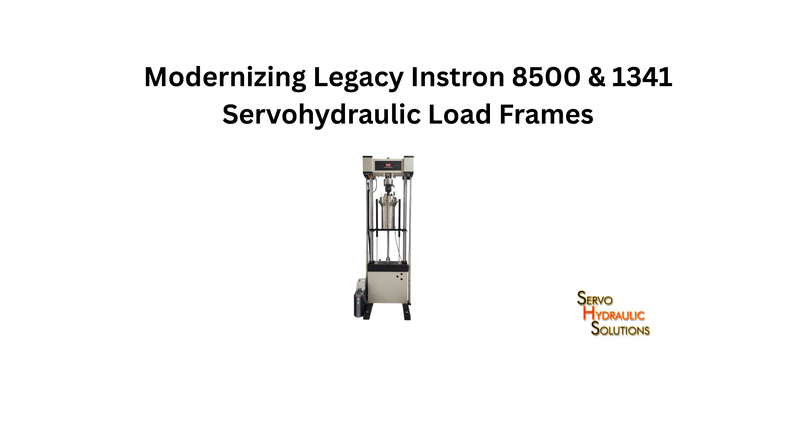
An older Instron 8500 or 1341 servohydraulic load frame can often be modernized without replacing the entire mechanical structure. An Instron 8500 controller upgrade or a legacy Instron 1341 servohydraulic retrofit can replace obsolete control electronics, update software, improve data acquisition and address valve or hydraulic interface problems while retaining suitable parts of the existing machine.
The right approach depends on the condition of the frame, the hydraulic system, the sensors and the tests the laboratory needs to perform. A retrofit is not simply a matter of connecting a new computer. The controller, servo valve, feedback devices and safety circuits must work together as one system.
Why Modernize a Legacy Instron Load Frame?
Many established testing laboratories have machines that remain mechanically useful but rely on ageing electronics. The frame may still provide the required force and stroke, yet the original controller, computer or software has become difficult to maintain.
Replacing the complete machine can be expensive and may require changes to foundations, fixtures, utilities and laboratory layouts. A carefully engineered retrofit offers another route.
Common Problems With Instron 8500 Systems
The Instron 8500 series is associated with servo hydraulic testing applications. However, the exact configuration, controller hardware and installed options can differ between machines.
Common issues in older installations include:
- Obsolete controller boards and electronic components.
- Ageing computers and software that are difficult to support.
- Limited availability of compatible replacement parts.
- Unreliable communication between control hardware and the operating computer.
- Outdated data acquisition and reporting capabilities.
- Difficulty integrating modern sensors or laboratory systems.
A machine might still operate, but maintaining it can become increasingly time-consuming. A failed controller component can also interrupt testing when replacement parts are difficult to source.
Common Problems With Instron 1341 Systems
Older Instron 1341 servo hydraulic frames may face similar electronics and support issues. Their condition depends on the machine’s original configuration, service history and previous modifications.
Potential concerns include:
- Ageing analogue or digital control electronics.
- Unstable sensor signals or inconsistent feedback.
- Worn hydraulic seals, hoses and fittings.
- Servo valve performance problems.
- Limited compatibility with current data acquisition systems.
- Older software that restricts reporting or test automation.
Distinguish an electronics problem from a mechanical or hydraulic fault. Replacing a controller will not correct a leaking cylinder, worn bearing or damaged valve.
Risks of Continuing With Obsolete Electronics
Keeping an older system running without a clear maintenance plan can create several problems.
Unplanned downtime: A failed electronic component may stop testing until a suitable replacement is found.
Limited support: Older computers, operating systems and proprietary interfaces may no longer receive updates or technical support.
Data management difficulties: Laboratories may struggle to transfer test results into modern storage, analysis or quality-management systems.
Safety concerns: Ageing control hardware can make it difficult to maintain dependable monitoring and emergency-stop functions. Safety circuits should be assessed independently rather than assumed to remain suitable.
Increasing maintenance effort: Engineers may spend more time troubleshooting old electronics instead of maintaining test schedules.
Benefits of a Modern Retrofit
A properly planned retrofit can extend the useful life of a suitable load frame.
| Upgrade area | Potential benefit |
| Digital controller | Modern control architecture and improved serviceability |
| Data acquisition | Better recording and export of test data |
| Control software | Updated test configuration and operating interface |
| Sensor interfaces | Support for suitable existing or new transducers |
| Servo valve interface | Improved compatibility with the selected control hardware |
| Safety circuits | Updated monitoring and protection arrangements |
| Electrical cabinet | Easier maintenance and component identification |
The main advantage is that laboratories can modernize the parts that need attention while retaining mechanically sound equipment.
What Is an Instron 8500 Controller Upgrade?
An Instron 8500 controller upgrade replaces or updates the control hardware that manages the machine’s testing functions. Depending on the existing configuration, this may include the controller, signal-conditioning electronics, valve-drive interface, computer and control software.
The objective is to restore maintainable operation and provide the control and data capabilities the laboratory requires.
How the Instron 8500 System Works
A servo hydraulic testing machine uses hydraulic power to produce controlled movement or force. The controller receives a test command and compares it with sensor feedback.
A simplified control sequence looks like this:
- The operator selects a test method and operating limits.
- The controller receives the requested force, displacement or other control command.
- Feedback sensors measure the machine’s response.
- The controller processes the difference between the command and measured response.
- The control output drives the servo valve.
- The valve regulates hydraulic flow to the actuator.
- The system continuously monitors feedback during the test.
This is a closed-loop control process. Its performance depends on the complete system, not just the controller.
The controller must be matched to the servo valve, actuator, sensors and hydraulic supply. A modern computer alone cannot improve the machine’s control performance.
What Can Be Replaced During an Upgrade?
Depending on the assessment, an Instron 8500 upgrade may include:
- Main controller and control-processing hardware.
- Analogue input and output modules.
- Servo valve amplifier or drive electronics.
- Sensor signal-conditioning modules.
- Computer and operating software.
- Data acquisition hardware.
- Digital controller upgrade.
- Electrical cabinet components.
- Communication interfaces and wiring.
Not every installation requires all these changes. The retrofit specification should identify which components are faulty, obsolete or unsuitable for the intended operating requirements.
What Can Be Retained From the Existing Frame?
A major reason for considering a retrofit is the possibility of retaining useful equipment.
Components that may be reusable include:
- Load frame and structural columns.
- Hydraulic actuator and cylinder.
- Existing hydraulic power unit.
- Load cells and displacement transducers.
- Extensometers.
- Servo valves.
- Fixtures and specimen grips.
- Hydraulic piping and manifolds.
Retention should follow inspection and compatibility checks. A component that physically fits may still have unsuitable electrical characteristics, performance limitations or safety concerns.
For example, an existing load cell may be mechanically sound but require a signal conditioner that is compatible with the new controller.
Software-Only Upgrade vs Full Electronics Retrofit
These are two different approaches.
| Area | Software-only upgrade | Full electronics retrofit |
| Main change | Operating or test software | Controller hardware and software |
| Existing electronics | Mostly retained | Replaced where required |
| Sensor interfaces | Usually retained | Can be updated |
| Valve-drive electronics | Usually retained | Can be replaced or adapted |
| Integration effort | Depends on existing compatibility | Usually more extensive |
| Suitable when | Hardware remains supported and functional | Electronics are obsolete or unreliable |
A software-only upgrade is practical when the existing control hardware can communicate reliably with the new software and still meets the required performance. legacy servo-hydraulic systems with COTS retrofits.
If the controller is obsolete or its interfaces cannot support the required functions, a wider retrofit may be necessary.
When a Full System Replacement Is Better
A retrofit is not always the economical choice. Full replacement deserves consideration when:
- The load frame has significant structural damage.
- The actuator or hydraulic system is beyond economical repair.
- The machine cannot meet the required force, stroke or frequency range.
- Essential components are unavailable and cannot be safely replaced.
- The required testing application is substantially different from the original design.
- The cost and technical risk of the integration approach match those of a replacement system.
The decision should compare the condition, capability, risk and lifecycle cost of both options, and evaluate whether investing in modern testing systems provides better long-term value.
Legacy Instron 1341 Servo hydraulic Retrofit
A legacy Instron 1341 servo hydraulic retrofit follows the same basic principle: retain suitable mechanical and hydraulic equipment while updating the control and support systems.
The details must be established from the actual machine. Different configurations may have different sensors, valve arrangements, controller electronics and hydraulic connections.
How the Instron 1341 System Works
The machine uses hydraulic pressure to drive its actuator. A control system regulates actuator movement or force based on the selected test command and feedback from measurement devices.
The control electronics process sensor signals and generate outputs for the valve-drive system. The servo valve then regulates hydraulic flow to achieve the requested response.
For a successful retrofit, engineers need to understand the existing control loop before disconnecting or replacing components.
What Can Be Replaced During a 1341 Retrofit?
A retrofit may involve:
- Legacy controller electronics.
- Analogue signal-processing boards.
- Valve amplifier and drive modules.
- Computer and software.
- Data acquisition interfaces.
- Electrical wiring and cabinet components.
- Sensor conditioning and communication hardware.
The replacement scope should be based on an inspection, not a standard parts list. A laboratory may need only a controller and software change, while another may require a more complete electrical and hydraulic interface upgrade.
What Can Be Retained From the Existing Frame?
The structural frame is often the first component considered for retention, provided it passes an appropriate condition assessment.
Other potentially reusable components include the actuator, hydraulic power unit, load cell, displacement sensor, fixtures and servo valve.
Before reuse, engineers should check:
- Mechanical condition and wear.
- Electrical signal ranges and wiring.
- Sensor calibration and traceability.
- Hydraulic pressure and flow requirements.
- Valve condition and response.
- Compatibility with the proposed controller.
The objective is to preserve proven equipment while avoiding components that could compromise reliability or performance.
Servo Valve and Hydraulic Component Upgrades
The servo valve plays a central role in a servo hydraulic system. It regulates hydraulic flow in response to the controller’s output.
An old valve may still be serviceable, but its condition and electrical characteristics need to be checked. Relevant factors include:
-
Rated flow and pressure.
-
Required drive current or voltage.
-
Electrical connector and wiring arrangement.
-
Null position and response characteristics.
-
Internal leakage and contamination sensitivity, verified through professional servo-hydraulic services.
-
Compatibility with the selected valve amplifier.
Hydraulic components also deserve attention. Filters, hoses, seals, manifolds and fittings should be inspected for wear, leakage and suitability.
Replacing the controller without checking the valve can lead to an incomplete upgrade. The new control hardware must be configured for the actual valve and hydraulic system.
When a Full System Replacement Is Better
If the 1341 frame has major structural or actuator damage, or cannot meet the laboratory’s testing requirements, a replacement machine may be the better investment.
A full replacement may also be appropriate when the hydraulic power unit, control architecture and major mechanical components all require substantial work.
The decision should be based on a documented technical assessment and a realistic comparison of retrofit and replacement costs.
Instron Load Frame Electronics and Valve Upgrade
An Instron load frame electronics and valve upgrade should be treated as an integrated engineering project. The controller, sensors, valve electronics and hydraulic system must be compatible.
Replacing Obsolete Control Electronics
Modern control electronics can replace ageing boards and provide a more maintainable control architecture.
The replacement system may include:
- Digital controller hardware.
- Analogue and digital input/output modules.
- Signal-conditioning electronics.
- Servo valve drive modules.
- Communication interfaces.
- A modern electrical cabinet.
Before selecting hardware, engineers should document the original input and output signals. This includes sensor ranges, valve-drive requirements, feedback scaling and electrical protection.
Matching connector types alone is not enough. Signal levels and operating characteristics must also match. When modernizing valve electronics and sensor conditioning on older test stands, analog-to-digital servo valve amplifier upgrades help align signal scaling, wiring, and feedback compatibility before full commissioning.
Upgrading Servo Valves and Hydraulic Components
The servo valve must be selected according to the actuator and hydraulic system’s operating requirements.
An oversized or undersized valve can affect response and control stability. Engineers should consider rated flow, operating pressure, actuator demand and required dynamic performance.
Hydraulic inspections should cover:
- Oil condition and cleanliness.
- Filter condition and rating.
- Hose and fitting integrity.
- Cylinder leakage.
- Manifold condition.
- Hydraulic power unit performance.
A new valve should not be treated as an automatic performance improvement. Its suitability depends on the complete hydraulic circuit and controller configuration.
Updating Load Cells and Transducers
Load cells, displacement transducers and extensometers provide the feedback used to measure test performance.
Existing sensors may be reusable if their condition, calibration and electrical characteristics are acceptable.
Before connecting them to new electronics, verify:
- Signal type and output range.
- Excitation requirements.
- Sensitivity and scaling.
- Connector and wiring configuration.
- Calibration status.
- Measurement range and accuracy requirements.
If an existing sensor is damaged or unsuitable, you may need a replacement. The controller configuration must then be updated to reflect the new sensor’s characteristics.
Integrating Safety Interlocks and Emergency Stops
Safety should be part of the retrofit specification from the beginning.
The system may require checks or upgrades to:
- Emergency-stop circuits.
- Hydraulic pressure monitoring.
- Actuator travel limits.
- Overload protection.
- Guard and access interlocks.
- Safe shutdown and restart procedures.
The emergency-stop function should not depend solely on ordinary test-control software. Safety-related functions need an appropriate, independently assessed design.
Inspect and validate the completed system before returning it to routine testing.
Matching Electronics to Hydraulic Performance
A controller cannot compensate for an unsuitable hydraulic system.
For example, if the actuator requires more flow than the hydraulic power unit can supply, changing the control electronics will not solve the underlying limitation.
Likewise, a servo valve with unsuitable flow characteristics may limit the machine’s response.
The engineering assessment should consider:
- Actuator force and stroke requirements.
- Hydraulic pressure and available flow.
- Servo valve capacity and response.
- Sensor feedback quality.
- Control-loop requirements.
- Intended test waveforms and operating frequency.
The target is a balanced system in which the electronics and hydraulic components operate within their intended limits.
COTS Software Upgrade for Legacy Instron Frames
A COTS software upgrade for legacy Instron frames uses commercially available control or data acquisition software instead of relying entirely on older proprietary software.
COTS means commercial off-the-shelf. It does not mean that the software can be installed without engineering work. The control hardware, interfaces and machine configuration still need to be compatible.
What Is a COTS Software Upgrade?
A COTS-based upgrade may use commercially available software and compatible controller hardware to operate the machine and collect test data.
Depending on the application, the software may support:
- Force and displacement control.
- Test sequence configuration.
- Live measurement display.
- Data recording and export.
- Test result calculations.
- User access management.
- Reporting and data storage.
The software must support the required control functions, not just display measurement values. Closed-loop control requires suitable hardware, real-time performance and a properly configured interface.
Benefits of Modern Control Software
A suitable modern software platform can make laboratory operations easier to manage.
Potential benefits include:
- More flexible test configuration.
- Improved data export and reporting.
- Easier integration with laboratory computers.
- Better access to recorded test information.
- More maintainable software and hardware arrangements.
- Reduced dependence on unsupported legacy operating environments.
For laboratories that handle different specimen types, flexible test configuration can be especially useful. However, the available functions depend on the selected platform and its integration.
Limitations of Software-Only Upgrades
Software cannot repair failed electronics or correct an incompatible valve-drive circuit.
A software-only approach may not work when:
- The original controller is no longer functional.
- Communication protocols are unsupported.
- Sensor inputs are incompatible.
- Valve-drive electronics cannot be configured for the new system.
- Real-time control requirements cannot be met.
- Existing safety functions cannot be adequately maintained.
In these situations, the project may need new controller hardware, interface electronics, and software.
When Custom Interface Engineering Is Needed
Older machines often have unique wiring, signal ranges or control arrangements. Custom interface engineering may be required to connect existing equipment to modern hardware.
This can include:
- Mapping legacy input and output signals.
- Designing sensor-conditioning interfaces.
- Matching servo valve drive requirements.
- Adapting communication connections.
- Updating electrical drawings.
- Integrating safety circuits.
- Testing control response and system limits.
The interface design should be documented so future maintenance engineers can understand how the upgraded system operates.
How to Avoid OEM Lock-In
Reducing dependence on a single supplier is a reasonable objective, particularly when maintaining older equipment.
A practical approach is to specify:
- Documented electrical and hydraulic interfaces.
- Standard, supportable controller components where suitable.
- Accessible configuration and maintenance documentation.
- Exportable test data in commonly usable formats.
- Clear software licensing and ownership terms.
- Availability of replacement hardware.
- Defined responsibilities for future technical support.
Avoid assuming that every COTS product is automatically open or interchangeable. Confirm software licensing, hardware compatibility and access to configuration files before approving the retrofit.
How to Plan an Instron Retrofit
A successful Instron retrofit begins with a detailed assessment. This reduces the risk of discovering major compatibility problems after the old electronics have already been removed.
Audit the Existing Load Frame
Start by recording the machine’s configuration and operating condition.
The audit should cover:
- Model and available configuration information.
- Frame capacity and mechanical condition.
- Actuator stroke and operating limits.
- Hydraulic power unit details.
- Existing controller and computer.
- Current software and available documentation.
- Known faults and maintenance history.
Photographs of the electrical cabinet, connectors, hydraulic components and machine nameplates can help during technical discussions.
Identify Sensors, Valves, and Hydraulic Components
Prepare an inventory of all important feedback and control devices.
| Component | Information to record |
| Load cell | Capacity, output, sensitivity and calibration |
| Displacement sensor | Type, range and output |
| Extensometer | Measurement range and interface |
| Servo valve | Model, flow rating and drive requirements |
| Hydraulic power unit | Pressure, flow and condition |
| Controller | Hardware configuration and available signals |
This inventory helps determine which parts can be reused and which require replacement or interface adaptation.
Define Control and DAQ Requirements
The laboratory should clearly state what the upgraded machine needs to do.
Consider:
- Force, displacement or other required control modes.
- Required test frequency and waveform.
- Measurement channels.
- Sampling and recording requirements.
- Test sequence complexity.
- Data export formats.
- Reporting and traceability needs.
- User access and operating procedures.
Define these requirements before choosing software. Otherwise, the laboratory may purchase a platform that records data well but lacks the required control functions.
Plan Electrical, Hydraulic, and Safety Interfaces
This is one of the most important stages.
The retrofit team should prepare electrical and hydraulic interface documentation covering sensor connections, signal conditioning, valve-drive outputs, power requirements and safety circuits.
The design should also identify how the upgraded system will respond to faults, loss of feedback, hydraulic pressure problems and emergency-stop activation.
Any changes to the hydraulic circuit should be reviewed for pressure ratings, component compatibility and safe operation.
Prepare a Migration and Commissioning Plan
The migration plan should explain how the existing system will be disconnected, upgraded and tested.
A sensible sequence is:
- Record the original configuration and back up available software and settings.
- Inspect and document the mechanical and hydraulic systems.
- Confirm the replacement hardware and interface design.
- Install the new controller and electrical components.
- Configure sensors, valve drives and software.
- Verify safety functions and operating limits.
- Perform controlled commissioning tests.
- Check measurement accuracy and control response.
- Document the final configuration and train operators.
Begin commissioning with controlled, low-risk checks. Full-load and dynamic testing should follow only after the relevant safety and performance checks are complete.
Compare Retrofit Quotations
Do not compare quotations on controller price alone. A low initial price may exclude important integration work.
Ask each supplier to itemize:
- Controller and software.
- Electrical cabinet and wiring.
- Sensor interfaces.
- Servo valve and hydraulic work.
- Safety-system changes.
- Installation and commissioning.
- Calibration and validation.
- Documentation and operator training.
- Warranty and ongoing support.
Also ask which existing components will be retained and what condition checks support that decision.
A useful quotation should describe the expected operating envelope after the retrofit, including any limitations. This makes it easier to compare proposals on technical value rather than price alone.
Conclusion
Modernizing an Instron 8500 or 1341 servo hydraulic load frame can be a practical alternative to replacing the entire machine, provided the frame and major hydraulic components remain suitable for continued use.
An Instron 8500 controller upgrade may involve new control electronics, software and data acquisition, while a legacy Instron 1341 servo hydraulic retrofit may also require attention to valve interfaces and hydraulic components. The best solution depends on the machine’s actual configuration and the laboratory’s testing requirements.
The key is to assess the complete system before selecting replacement hardware. A well-documented retrofit, with compatible electronics, validated safety functions and proper commissioning, can provide a more maintainable testing platform without discarding equipment that still has useful service life.
FAQs
1. Can a legacy Instron 8500 load frame be upgraded with a modern controller?
Yes, it may be possible if the frame, actuator, hydraulic system and sensors are suitable for continued use. The replacement controller must be compatible with the existing feedback devices and servo valve, or suitable interface electronics must be designed.
2. Can an Instron 1341 servo hydraulic frame be retrofitted without replacing the frame?
Yes. A retrofit may retain the existing frame and other serviceable components while replacing obsolete electronics, software or valve interfaces. A mechanical and hydraulic inspection is needed before confirming feasibility.
3. What is an Instron 8500 controller upgrade?
It upgrades the machine’s control hardware and related systems. Depending on the configuration, it can include a digital controller, valve-drive electronics, sensor interfaces, computer and control software.
4. What is a legacy Instron 1341 servo hydraulic retrofit?
It is the modernization of an older Instron 1341 servo hydraulic testing machine. The work may involve controller replacement, software updates, electrical modifications, and inspection or upgrading of hydraulic components.
5. What components can be retained during an Instron load frame upgrade?
Potentially reusable components include the structural frame, actuator, hydraulic power unit, load cells, displacement sensors, extensometers, servo valves and fixtures. Each component must pass condition and compatibility checks.
6. What components usually need to be replaced during an Instron retrofit?
Common replacement candidates include obsolete controller boards, unsupported computers, outdated software, signal-conditioning modules and incompatible valve-drive electronics. The actual scope depends on the machine’s condition and configuration.
7. Can existing load cells and extensometers be reused after an Instron upgrade?
Yes, if they are in good condition, appropriately calibrated and electrically compatible with the new controller. Signal conditioning, excitation requirements and measurement scaling must be verified.
8. Can existing servo valves be reused during an Instron controller upgrade?
Possibly. The valve should be inspected, and its electrical drive requirements, flow capacity and response characteristics checked against the replacement controller and amplifier. Do not assume reuse based on physical compatibility alone.
9. Do I need to replace the hydraulic power unit during an Instron retrofit?
Not necessarily. An existing hydraulic power unit may be retained if it provides suitable pressure and flow and passes condition checks. Leakage, contamination, inadequate flow or poor performance may justify repair or replacement.
10. What is the difference between a software-only upgrade and a full electronics retrofit?
A software-only upgrade updates the operating or test software while retaining most existing control hardware. A full electronics retrofit replaces or adapts the controller, signal interfaces, and potentially valve-drive hardware, along with the software.
Ready to Modernize Your Legacy Instron 8500 or 1341 System?
Whether you need a full digital controller upgrade, COTS software integration, custom interface engineering, or a comprehensive technical assessment of your load frame and hydraulic components, our engineering experts are here to help.