- Have any Query
- (303) 807-1061
- doug@servohydraulicsolutions.com

Backlash-Free Swivels & Hydrostatic Bearings in Shake Tables

Quasi-Static Cyclic Testing for Concrete & Steel Joints
November 7, 2026
Energy Efficient Servo Hydraulics for Shake Table Testing Labs
November 11, 2026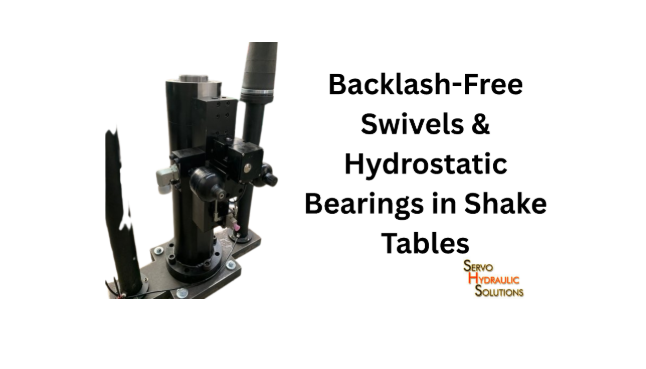
Backlash-free swivels and hydrostatic bearings help servo-hydraulic shake tables deliver smooth, controlled motion by reducing mechanical play, friction, and unwanted resistance at critical moving connections. They are especially useful in demanding seismic simulations and high-frequency vibration testing, where an actuator assembly’s mechanical behavior can affect motion accuracy, repeatability, and overall system performance.
A shake table is only as effective as the complete system behind it. Actuators, servo valves, hydraulic power units, sensors, bearings, and mechanical joints must work together to reproduce the required movement. Even a powerful hydraulic actuator can struggle to deliver consistent motion if its connections introduce looseness, binding, or unwanted side loads.
That is why backlash-free swivel servo hydraulic components deserve attention during shake table design, equipment upgrades, and maintenance. The right combination of low-backlash joints and suitable bearing technology can improve mechanical consistency, although the final result still depends on the entire hydraulic and control system.
What Are Backlash-Free Swivels in Servo-Hydraulic Shake Tables?
A backlash-free swivel is a mechanical joint that transmits force while allowing the angular movement an assembly requires, with minimal lost motion when the load direction changes.
In a servo-hydraulic shake table, actuators repeatedly push and pull the moving platform to reproduce a programmed test signal. Depending on the table’s geometry, the actuator may need to accommodate small angular changes as the platform travels through its operating range.
A suitable swivel allows this movement without introducing excessive clearance or restricting the intended motion.
Why does mechanical backlash matter?
Backlash is unwanted free movement between connected mechanical parts. It often becomes noticeable when a load reverses direction, and one surface must move across a clearance before the opposite surface begins carrying the load.
In a slowly moving mechanism, that clearance may have little practical effect. In a shake table operating through repeated dynamic cycles, it can create a more noticeable problem.
Potential consequences include:
- Delayed force transfer during load reversals.
- Small differences between commanded and actual movement.
- Impact-related noise from mechanical clearance.
- Less consistent response between repeated test cycles.
- Additional difficulty when tuning the servo-hydraulic control system.
The impact depends on clearance, joint stiffness, applied load, frequency, and overall mechanical design. Backlash-free construction aims to minimize this source of unwanted movement, rather than eliminate every possible source of motion error.
How do backlash-free swivels work?
Different designs use different mechanisms to reduce play. Some incorporate preloaded rolling-element bearings, while specialized designs may use hydrostatic bearing surfaces.
Preloaded bearings maintain contact within the bearing assembly to reduce clearance. Hydrostatic designs use a pressurized fluid film to support loads while separating the main bearing surfaces.
The suitable design depends on factors such as:
- Axial force and cyclic loading.
- Allowable angular movement.
- Required stiffness and fatigue life.
- Operating frequency and motion profile.
- Lubrication, hydraulic supply, and maintenance requirements.
A component should not be selected simply because its product description says “backlash-free.” Engineers need to understand how its performance is specified and whether the rating applies under the actual operating conditions.
What Are Hydrostatic Bearings in Shake Tables?
Hydrostatic bearings support moving components through a pressurized fluid film, usually supplied by a hydraulic circuit. Instead of relying on direct contact between the primary loaded surfaces, the bearing uses fluid pressure to carry the load.
When properly designed and maintained, this arrangement can provide low-friction movement, high stiffness, and good load-support characteristics.
In shake tables, hydrostatic bearing arrangements may be used in linear guides, actuator assemblies, sliding supports, and specialised mechanical joints. including dedicated hydrostatic bearing slip table systems for horizontal vibration testing. The exact configuration depends on the table’s design and required degrees of freedom.
How hydrostatic bearings operate
Pressurized hydraulic fluid enters carefully designed bearing pockets or passages. The resulting fluid film separates the supporting surfaces and carries the applied load.
For reliable operation, the system must maintain the required pressure, flow, clearance, and fluid condition.
Important design considerations include:
- Supply pressure: Must support the expected load across the intended operating range.
- Oil flow: Must maintain the bearing film and account for leakage through the bearing clearance.
- Bearing clearance: Affects load capacity, stiffness, leakage, and operating stability.
- Fluid cleanliness: Contamination can obstruct precision passages and damage critical surfaces.
- Oil temperature: Viscosity changes can affect flow and bearing performance.
- Load distribution: Uneven loading can change the fluid-film thickness and compromise the intended operating conditions.
Hydrostatic bearings therefore need a suitable fluid supply and maintenance plan. Their low-friction operation does not mean the supporting hydraulic equipment can be ignored.
Why choose hydrostatic bearings over conventional sliding bearings?
Conventional sliding surfaces can experience friction that varies with load, lubrication, temperature, surface condition, and movement speed. During repeated reversals, this changing resistance can affect how consistently the mechanical assembly responds.
A properly designed hydrostatic bearing can reduce friction at the supported interface while maintaining load capacity. This makes it attractive for applications that require smooth movement under substantial loads.
There are trade-offs. Hydrostatic bearings require a reliable pressure supply, appropriate filtration, and careful management of fluid leakage and temperature. A conventional bearing may be more suitable where the load, speed, accuracy requirements, and maintenance arrangements do not justify a hydrostatic design.
Base the decision on the complete application, not on the assumption that one bearing technology is always superior.
Backlash-Free Swivels vs. Hydrostatic Bearings
These components address different mechanical requirements, although they can be used together in the same assembly.
A swivel accommodates angular movement while transmitting force. A hydrostatic bearing supports movement through a pressurised fluid film. Some specialised swivels incorporate hydrostatic bearing surfaces, combining angular accommodation with fluid-film support.
| Feature | Backlash-free swivel | Hydrostatic bearing |
|---|---|---|
| Main purpose | Transmits force while accommodating angular movement | Supports loads while allowing low-friction movement |
| Primary concern | Mechanical play, alignment, and joint movement | Friction, stiffness, load capacity, and fluid-film stability |
| Typical use | Actuator-end connections and self-aligning joints | Linear guides, sliding supports, and specialised bearing assemblies |
| Key specifications | Force rating, angular travel, stiffness, fatigue life | Supply pressure, flow, clearance, stiffness, and fluid requirements |
| Main maintenance concerns | Wear, lubrication, alignment, and joint condition | Fluid cleanliness, supply stability, seals, and bearing condition |
| Potential contribution | More consistent force transfer through load reversals | Smoother supported movement and reduced friction-related disturbance |
For example, a multi-axis shake table may require swivels to accommodate changes in actuator angle and bearings to guide the moving platform. Each component must perform its role without introducing unwanted forces or restricting the intended motion.
How These Components Improve Shake Table Performance
Shake table performance depends on much more than actuator force. The actuator must move the platform through the required stroke, respond to changing commands, support the test specimen, and reproduce the intended motion within the system’s operating limits.
Backlash-free swivels and hydrostatic bearings can improve the mechanical conditions under which that motion occurs.
1. More consistent force transmission
During earthquake simulation, an actuator may reverse direction many times while reproducing a recorded or generated ground-motion signal.
If a mechanical joint has excessive clearance, some movement may occur before the connection transfers force in the opposite direction. A suitable backlash-free swivel helps minimise this lost motion.
This matters when a test includes repeated load reversals or when multiple actuators must work together. More consistent mechanical connections give the control system a better foundation for reproducing the requested motion.
2. Reduced friction-related disturbance
Friction can affect the force required to initiate or maintain movement. It can also vary as load, temperature, lubrication, and direction of motion change.
Hydrostatic bearings reduce direct contact at the main bearing surfaces, potentially limiting friction-related variation. This can be useful when a moving platform must travel smoothly under a heavy payload.
However, friction can still exist elsewhere in the assembly, including seals, mechanical joints, and guides. A hydrostatic bearing should be viewed as one part of a broader friction-management strategy.
3. Better test repeatability
Repeatability means obtaining comparable results when the same test is repeated under equivalent conditions.
Mechanical clearance, changing friction, misalignment, and wear can all influence the relationship between actuator commands and actual platform movement.
Reducing these effects helps limit one source of variation. For example, a laboratory comparing the response of several structural models needs confidence that differences in measured behaviour reflect the specimens rather than changing mechanical conditions in the test equipment.
Bearings and swivels alone cannot guarantee repeatability. Calibration, sensor quality, control tuning, specimen mounting, and consistent test procedures remain important.
4. Improved multi-axis coordination
A multi-axis shake table may reproduce horizontal, vertical, and rotational movement through several coordinated actuators. Each actuator and joint must accommodate the platform geometry without binding or introducing excessive side loads.
In multi-axis systems, engineers must also focus on managing cross-coupling and pitch interference to ensure the platform responds accurately across all degrees of freedom.
A joint that restricts angular movement or has excessive play can complicate the connected actuator’s motion. Similarly, a bearing arrangement that introduces uneven resistance may affect how the platform responds across its operating range.
Suitable swivels and bearing systems help manage these mechanical challenges. Correct sizing and alignment remain essential, particularly in systems with multiple actuators and tightly controlled motion requirements.
5. Reduced unwanted mechanical noise
Reducing shake table mechanical noise involves more than lowering the sound heard in a laboratory. Mechanical vibration and impacts from the test equipment can also affect measurements, making it harder to separate the specimen’s response from the machine’s behavior.
Loose joints may produce impact-related noise. Friction, binding, misalignment, and worn bearing surfaces can introduce additional vibration.
Backlash-free swivels can reduce noise associated with mechanical clearance, while hydrostatic bearings can limit friction-related disturbance at supported surfaces.
Other sources may remain, including hydraulic pump noise, pressure pulsation, servo-valve behavior, structural resonance, and movement in specimen fixtures. A noise problem should be investigated systematically rather than attributed to a single component.
Hydrostatic Bearing Actuators: What Engineers Should Know
Hydrostatic bearing actuators combine hydraulic force generation with a bearing arrangement that supports movement under load while reducing friction at critical interfaces.
Their performance depends on both the actuator and the mechanical support system around it. An actuator must provide the required force and stroke while maintaining alignment and operating within its specified load limits.
Managing side loads and alignment
Servo-hydraulic actuators are generally designed around defined limits for axial force, lateral loading, bending moment, and angular misalignment.
If the mounting arrangement introduces excessive side loads, the actuator may experience additional friction, wear, seal damage, or reduced service life.
Suitable bearings and swivels help accommodate the intended geometry, but they do not make an actuator immune to incorrect alignment.
Consider a shake table carrying an asymmetrical test specimen. Its mass distribution and motion may create loads that need to be considered throughout the actuator stroke. The mounting arrangement must transfer those loads without exceeding the actuator’s permitted side-load or bending limits.
Engineers should therefore check the load path, joint geometry, bearing capacity, and alignment together.
Supporting high-frequency performance
High-frequency vibration testing hardware must respond to rapidly changing commands within the limits of the mechanical, hydraulic, and control systems.
As frequency increases, the time available to respond during each cycle becomes shorter. Friction, structural flexibility, payload inertia, oil compressibility, servo-valve dynamics, and controller bandwidth all influence performance.
Hydrostatic bearing actuators may help reduce friction at relevant interfaces, but the bearing type alone does not determine the usable frequency range.
Before selecting a system, review the required combination of frequency, displacement, velocity, acceleration, payload, and duty cycle. A table may achieve a particular frequency at a small amplitude but fail to reproduce it at a much larger amplitude.
The complete operating envelope is what matters.
Servo Valve Dynamic Testing Components and Mechanical Behaviour
Servo valves control hydraulic fluid flow to the actuator. They are central to servo-hydraulic testing because their response affects how quickly and accurately the actuator can follow a command.
However, a servo valve does not operate independently of the mechanical system. Its output interacts with the actuator, hydraulic supply, load, bearings, joints, sensors, and controller.
How mechanical components affect servo-valve response
When the controller sends a command, the servo valve adjusts hydraulic flow. The actuator then responds to the resulting pressure and force conditions.
If the connected mechanism has excessive backlash, binding, or changing friction, the resulting motion may differ from the intended response. The control system may compensate for some effects, but compensation has limits.
Reducing unnecessary mechanical play and friction can help make the system more predictable. It also makes troubleshooting easier because fewer mechanical disturbances are affecting the measured response.
What should engineers inspect?
When a shake table fails to reproduce a test waveform consistently, examine the complete system.
- Servo valve: Check rated flow, pressure requirements, dynamic response, and condition.
- Hydraulic power supply: Review pressure stability, flow capacity, oil temperature, and fluid cleanliness.
- Actuator: Inspect alignment, seals, displacement feedback, and permitted side loads.
- Swivels and bearings: Check for looseness, binding, wear, and unsuitable movement.
- Control system: Review feedback signals, tuning, filtering, and command tracking.
- Measurements: Compare the command signal with measured actuator and table motion.
A distorted waveform does not automatically mean the servo valve is faulty. The cause may be hydraulic, mechanical, electrical, or a combination of several factors.
Practical Example: Diagnosing Inconsistent Motion During a Shake Table Test
Imagine a structural laboratory testing a building-frame model using repeated horizontal excitation. The measured table response differs slightly between runs, particularly near points where the motion changes direction.
Before adjusting the controller, the team should establish whether the inconsistency originates in the mechanical assembly.
A practical diagnostic sequence would be:
- Compare the commanded motion with measured actuator and platform displacement.
- Inspect the swivel connections for excessive play, damage, or restricted angular movement.
- Check the bearing and guide system for binding across the full stroke.
- Verify actuator alignment and mounting geometry.
- Review hydraulic pressure, servo-valve behavior, and feedback signals.
- Repeat the test under controlled conditions and compare the results.
If excessive clearance is identified, a suitable backlash-free swivel may address that particular issue. If the movement is restricted by bearing friction or alignment, the support system may need attention.
Replacing a component without identifying the cause wastes time and leaves the original problem unresolved. This example is an illustrative troubleshooting scenario, not a report of a specific customer installation.
How to Select Backlash-Free Swivels and Hydrostatic Bearings
The best component matches the shake table’s actual mechanical and dynamic requirements. A swivel or bearing that performs well in one system may be unsuitable for another with different loads, stroke, frequency, or mounting arrangements.
Use the following checks before making a selection.
1. Establish the load requirements
Document the expected axial force, cyclic loads, lateral forces, and bending moments. Include operating conditions that may occur during acceleration, deceleration, and load reversal.
Check the manufacturer’s ratings for the combined load conditions, not just the maximum axial force.
2. Confirm angular movement
For a swivel, determine the angular travel required across the full actuator stroke. Account for platform geometry and any changes introduced by multi-axis movement.
The joint must accommodate the required angle without binding or exceeding its specified limits.
3. Review backlash and stiffness
Establish how much lost motion the application can tolerate. Ask how backlash is measured, under what loading conditions, and whether the rating applies across the intended range of movement.
Stiffness matters too. A joint that minimizes clearance but introduces excessive flexibility may still affect dynamic response.
4. Check hydrostatic supply requirements
For a hydrostatic bearing, confirm the required pressure, flow, oil cleanliness, operating temperature, and acceptable leakage.
Determine how the bearing behaves if the pressure supply becomes unstable or is interrupted. Where appropriate, consider monitoring, interlocks, and protective measures specified by the manufacturer.
5. Match the component to the test profile
Consider frequency, displacement, velocity, acceleration, payload, and duty cycle together. Ask for technical evidence that the component is suitable for the intended application.
High-frequency performance depends on the entire system, so do not assume that installing a low-friction bearing automatically increases the table’s usable bandwidth.
6. Plan for maintenance
Review inspection intervals, lubrication needs, fluid filtration, seal replacement, and spare-part availability.
Hydrostatic bearings require reliable fluid management. Other bearing designs may have different wear and lubrication requirements. Choose a design that the laboratory can support over the expected service life.
7. Verify compatibility with the existing system
For a replacement or upgrade, check mounting dimensions, connection interfaces, actuator geometry, load ratings, and sensor arrangements.
For a replacement or upgrade, check mounting dimensions, connection interfaces, actuator geometry, load ratings, and sensor arrangements.
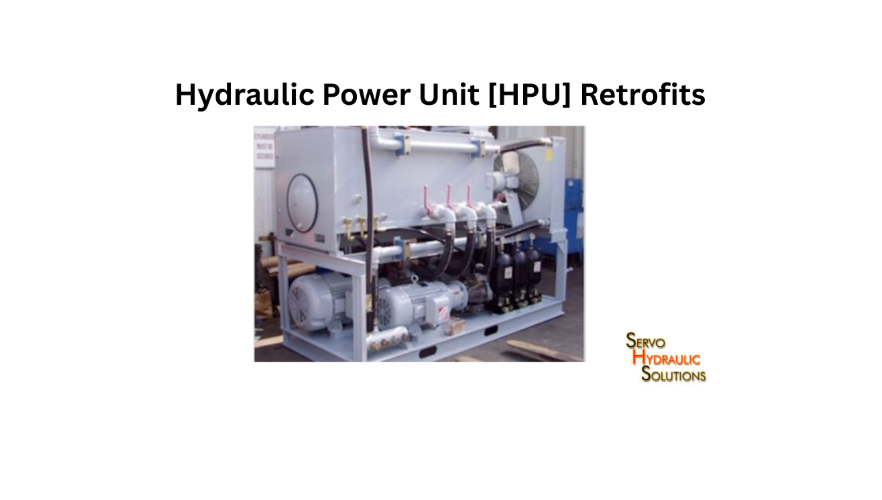
A hydraulic actuator test stand retrofit with upgraded joints and digital controllers can significantly enhance overall system performance
When modernizing older test setups, a hydraulic actuator test stand retrofit with upgraded joints and digital controllers can significantly enhance overall system performance—especially when combined with upgrading legacy hydraulic test stands with modern digital controllers to replace ageing electronics while keeping sound mechanical hardware.
Any change that affects alignment, stiffness, or the load path should be evaluated before the table returns to critical testing. Commissioning and performance verification may be necessary after installation.
Common Mistakes to Avoid
Even a well-designed swivel or bearing can underperform if it is selected without considering the rest of the machine.
- Choosing by force rating alone: The component may carry the axial load but lack the required angular travel, stiffness, or fatigue capability.
- Assuming backlash-free means error-free: Sensor errors, structural resonance, hydraulic nonlinearity, and control limitations can still affect motion.
- Ignoring fluid cleanliness: Contamination can interfere with hydrostatic bearing operation and damage precision hydraulic components.
- Overlooking side loads: Poor alignment can increase stress and wear even when the axial force remains within the rated limit.
- Using control tuning to hide mechanical faults: Controller adjustments should not replace repairs to worn joints, binding bearings, or unsuitable mounting arrangements.
- Skipping post-maintenance checks: After replacing a bearing or swivel, verify alignment and movement across the intended operating range.
A short, structured inspection can often reveal more than repeatedly changing controller settings without a clear diagnosis.
Recent Developments in Shake Table and Hydrostatic Bearing Research
Current engineering research continues to examine the relationship between mechanical behavior and control accuracy in hydraulic test systems.
A 2025 study, Dynamic Performance Analysis of Electro-hydraulic Servo Actuator with Hydrostatic Bearing, published in Chinese Hydraulics & Pneumatics, specifically examined the dynamic performance of an electro-hydraulic servo actuator incorporating a hydrostatic bearing. The research topic reflects ongoing interest in how bearing design influences actuator behavior.
In October 2025, a study published in Machines investigated how vibration affects servo-valve performance in electro-hydraulic shaking tables. It examined vibration-related interference and suppression methods, highlighting that the valve itself must operate reliably within a vibrating mechanical system.
Research published in Applied Sciences in February 2026 also examined control of redundantly actuated hydraulic shaking tables. The study addressed internal force coupling and waveform reproduction, illustrating the challenges that arise when several actuators must coordinate movement under complex loading.
These studies do not establish that one swivel or bearing design is best for every shake table. They point to a more useful conclusion: mechanical components, actuator dynamics, servo valves, and control algorithms need to be evaluated as an integrated system.
For engineers selecting hardware, this means checking component specifications against the required test conditions and verifying performance after installation.
Maintenance Best Practices for Swivels and Hydrostatic Bearings
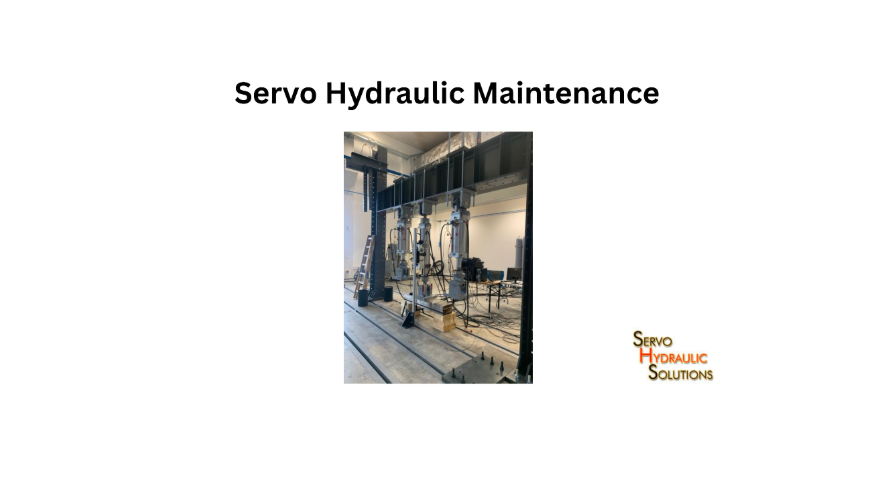
Routine inspection helps identify developing problems before they affect test results or cause unexpected downtime, as part of ongoing servo hydraulic maintenance and repair.
Inspect joints and connections.
Look for visible wear, looseness, damage, and signs of misalignment. Follow the manufacturer’s procedure for checking clearance and joint condition rather than applying an arbitrary acceptance limit.
Monitor hydraulic fluid and supply conditions.
Maintain fluid cleanliness, pressure, and filtration according to the bearing and hydraulic system specifications. Investigate leaks, unusual temperature changes, or unstable pressure.
Track changes in noise and motion.
A new clicking sound, vibration, increase in friction, or change in repeatability may indicate a developing issue.
Record when it occurs. Does it happen at a particular stroke position, frequency, load, or direction of movement? Those details can help narrow down the cause.
Check alignment after maintenance.
After replacing a swivel, bearing, or actuator, verify alignment and movement across the required operating range. Ensure the updated assembly doesn’t introduce unwanted side loads.
Keep maintenance and test records.
Document inspections, component replacements, operating conditions, and verification results. Consistent records help engineers identify gradual wear and determine whether performance changes followed a particular maintenance activity.
FAQs: Backlash-Free Swivels and Hydrostatic Bearings in Shake Tables
What is a backlash-free swivel in a servo-hydraulic system?
It is a mechanical joint that transfers force while allowing angular movement with minimal lost motion when the load direction changes. It can help improve consistency in dynamic applications involving repeated reversals.
How do hydrostatic bearings improve shake table performance?
Hydrostatic bearings use a pressurized fluid film to support loads and reduce direct contact between bearing surfaces. When designed and maintained correctly, they can provide low-friction movement and support repeatable dynamic operation.
Can backlash-free swivels reduce shake table mechanical noise?
They can reduce noise from mechanical clearance and joint impacts. They will not eliminate every noise source, since pumps, servo valves, hydraulic pulsation, structural resonance, and specimen fixtures may also contribute.
Are hydrostatic bearings suitable for high-frequency vibration testing?
They may be suitable when their load capacity, stiffness, fluid supply, and dynamic characteristics match the application. The usable test frequency also depends on the actuator, servo valve, payload, structure, hydraulic supply, and control system.
What is the difference between a hydrostatic and a conventional bearing?
A hydrostatic bearing uses externally pressurized fluid to support the load across a fluid film. A conventional bearing may use rolling elements or lubricated sliding surfaces. The appropriate choice depends on load, friction, stiffness, speed, precision, maintenance, and cost requirements.
Do hydrostatic bearings require maintenance?
Yes. They need appropriate fluid cleanliness, pressure and flow, temperature control, and inspection of related hydraulic components. Reduced contact wear does not eliminate the need for maintenance.
Can existing shake tables be upgraded with backlash-free swivels?
Potentially. Engineers must check the existing actuator geometry, mounting interfaces, force ratings, angular travel, stiffness, and operating conditions. The new component must fit the mechanical design without creating unwanted loads or restricting movement.
Conclusion
Backlash-free swivels and hydrostatic bearings help address two important mechanical challenges in servo-hydraulic shake tables: unwanted play at moving connections and friction at load-supporting interfaces. When selected and maintained correctly, they can support smoother motion, more consistent force transfer, and reduced mechanical disturbance.
The right choice depends on the actual test requirements. Force, stroke, frequency, angular movement, stiffness, fluid supply, and maintenance needs all matter. So does the interaction between the mechanical assembly and the servo-hydraulic control system.
For laboratories designing, maintaining, or upgrading shake tables, evaluating swivels and bearings alongside the actuators, servo valves, and control system is a practical way to support reliable dynamic testing.
To explore servo-hydraulic testing equipment and support, visit Servo Hydraulic Solutions or review its servo-hydraulic services.
Ready to Upgrade Your Servo-Hydraulic Testing Systems?
Discuss your custom shake table requirements, component specifications, or laboratory upgrade plans with our engineering experts today.