- Have any Query
- (303) 807-1061
- doug@servohydraulicsolutions.com

Custom High-Force Shaker Tables vs Standard Off-the-Shelf Platforms: When Bespoke Engineering Pays Off

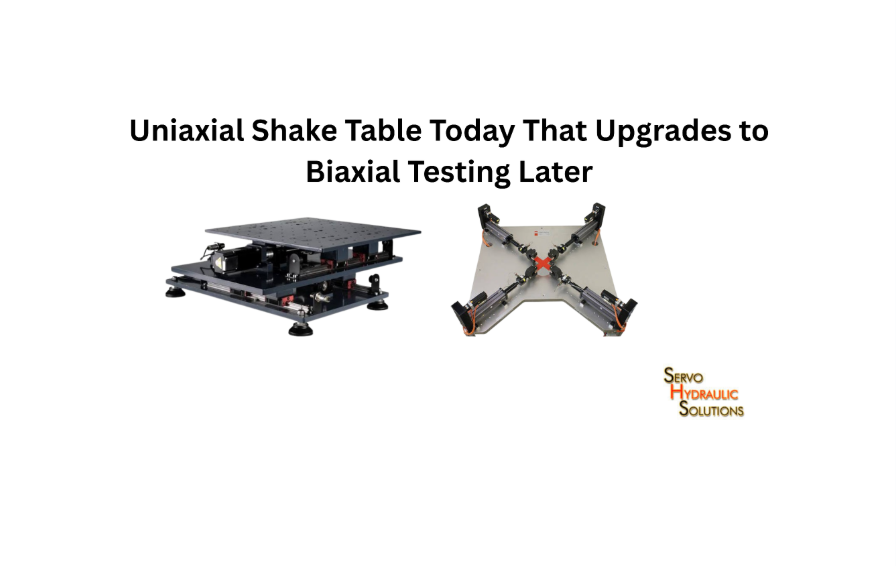
Phased Lab Expansion: How to Specify a Uniaxial Shake Table Today That Upgrades to Biaxial Testing Later
November 19, 2026
Upgrading Obsolete MTS 458, 407 & TestStar Hydraulic Test Stands with Modern COTS Digital Controllers
November 19, 2026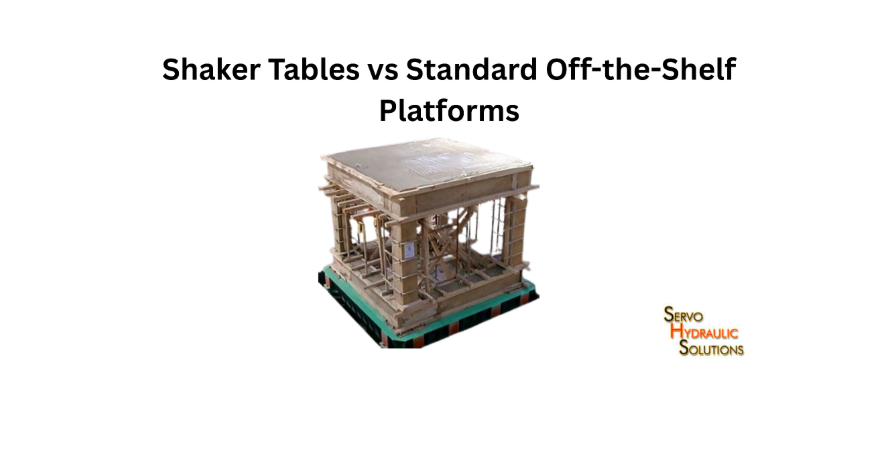
A custom servo-hydraulic shaker table is worth the investment when standard platforms cannot meet the required payload, force, displacement, frequency, or testing configuration. For laboratories with conventional testing needs, a pre-engineered platform is often more economical, but unusual specimens and demanding seismic tests may require bespoke engineering.
The decision should not be based on payload capacity alone. Table stiffness, actuator performance, overturning moment, hydraulic flow, foundation design, and control requirements all affect how well a shake table performs under real test conditions.
What Is a Custom Servo-Hydraulic Shaker?
A custom servo-hydraulic shaker is a vibration or seismic testing system engineered around specific specimen dimensions, dynamic loads, motion requirements, and laboratory conditions. Unlike a standard platform, its mechanical structure, actuator arrangement, hydraulic supply, and control system can be configured for a particular application.
This approach is useful when the test specimen falls outside the operating envelope of commercially available equipment.
How a Custom Servo-Hydraulic Shaker Table Works
A servo-hydraulic shaker uses pressurised hydraulic fluid to move an actuator connected to a test platform. A digital controller sends commands to a servo valve, which regulates fluid flow into the actuator. Feedback sensors continuously measure movement and help the controller reproduce the required test waveform.
A typical system includes:
- Shake table: Supports the specimen and transfers controlled movement.
- Hydraulic actuator: Generates the force and displacement required for testing.
- Servo valve: Controls hydraulic flow and actuator response.
- Hydraulic power unit: Supplies pressurised fluid at the required flow rate.
- Digital controller: Manages the commanded motion and feedback.
- Sensors and data acquisition: Record acceleration, displacement, force, pressure, and specimen response.
- Foundation and reaction structure: Resist the forces generated during operation.
In a custom system, these components are selected and integrated around the actual test requirements rather than a standard product configuration.
Difference Between Custom and Standard Platforms
| Consideration | Standard platform | Custom shaker table |
| Design | Pre-engineered configuration | Application-specific engineering |
| Payload | Defined operating range | Designed around specified specimens |
| Platform size | Available standard dimensions | Custom dimensions possible |
| Actuator arrangement | Established configuration | Can be adapted to the test |
| Hydraulic capacity | Defined system rating | Selected for required demand |
| Foundation | Standard installation requirements | May need project-specific design |
| Delivery | Often more predictable | Depends on engineering and fabrication |
| Initial cost | Generally lower | Generally higher |
Custom engineering provides flexibility, but that flexibility comes with additional design, integration, and validation work.
When a Custom Shaker Table Is Needed
Consider a custom system when:
- The specimen is unusually heavy, tall, or wide.
- The centre of gravity creates significant overturning loads.
- Standard actuators cannot meet the required force or stroke.
- The test requires an unusual frequency and acceleration combination.
- The laboratory needs a special actuator arrangement.
- Existing foundations or building dimensions restrict installation.
- The test requires a particular multi-axis configuration.
The key question is whether a standard platform can meet the complete test envelope, not just one headline specification.
What Is a Standard Off-the-Shelf Platform?
A standard off-the-shelf shake table is a pre-engineered system manufactured for a defined range of vibration or seismic testing applications. It typically comes with established platform dimensions, actuator ratings, control hardware, and installation requirements.
For laboratories performing common tests, this can be a practical way to obtain reliable testing capability without funding a complete custom design.
How a Standard Shake Table Works
A standard platform uses the same basic operating principle as a custom servo-hydraulic system. Its actuator generates controlled movement, while the hydraulic supply and controller manage the required motion.
The difference is that the major components and their arrangement have already been selected for a known operating range.
A laboratory can choose a suitable model based on payload, acceleration, stroke, velocity, frequency, and platform dimensions.
Benefits of Pre-Engineered Platforms
Standard platforms offer several advantages:
- Defined specifications: Buyers can review established operating limits before purchase.
- Simpler procurement: The basic configuration is already developed.
- Predictable integration: Installation requirements are generally documented.
- Component availability: Standard components may be easier to service or replace.
- Lower engineering effort: Less application-specific design is usually required.
- Established operation: The supplier may have previous experience with the same configuration.
For a university setting up its first seismic testing laboratory, these benefits can be more valuable than having every component customised.
Limitations of Standard Systems
A standard platform may become unsuitable when the specimen or test requirements exceed its design envelope.
Common limitations include:
- Insufficient actuator force.
- Limited platform dimensions.
- Inadequate stroke or velocity.
- Payload restrictions related to centre of gravity.
- Limited multi-axis capability.
- Foundation requirements that conflict with the existing facility.
It is important to check performance under the actual specimen load. A platform’s maximum payload rating does not mean it can achieve every advertised acceleration and frequency at that mass.
When a Standard Platform Is Enough
A standard platform is usually the better choice when the laboratory has clearly defined, conventional testing requirements and a suitable model meets them with adequate operating margin.
If the specimen fits the platform, the actuator meets the motion requirements, and the facility can support the installation, paying for extensive bespoke engineering may offer little practical benefit.
Custom vs Pre-Engineered MAST Tables
The choice between custom and pre-engineered MAST tables depends on the required number of motion axes, specimen characteristics, and performance envelope.
MAST stands for Multi-Axis Simulation Table. These systems reproduce controlled movement along multiple directions and are used when research requires more than conventional single-axis excitation.
What Is a MAST Shake Table?
A MAST shake table is designed to simulate motion along multiple axes, depending on its mechanical configuration. It can be used to investigate how structures, equipment, and components respond to combined movement.
Common applications include seismic qualification, structural dynamics research, and testing of equipment exposed to multi-directional vibration.
Standard MAST Configurations
Standard MAST systems are available in established configurations. Depending on the design, they may use coordinated actuators arranged along orthogonal directions or a multi-actuator hexapod arrangement.
Each configuration has different characteristics.
- Orthogonal systems use actuators arranged along defined directions to produce coordinated movement.
- Hexapod systems use six inclined actuators to generate controlled translational and rotational motion.
Neither arrangement is automatically better. Understanding the trade-offs between 6-DOF hexapod and orthogonal shake tables helps clarify how payload, centre of gravity, force, stroke, frequency, rotational requirements, and control performance shape the final selection.
Custom MAST Design Requirements
A custom MAST may be necessary when a standard configuration cannot accommodate the specimen or required motion.
The design review should consider:
- Number of required translational and rotational degrees of freedom.
- Payload and centre-of-gravity location.
- Actuator geometry and force capacity.
- Stroke, velocity, and acceleration.
- Cross-axis interaction.
- Platform stiffness.
- Hydraulic flow during simultaneous operation.
- Foundation and reaction loads.
A system with six motion degrees of freedom is not automatically necessary for every multi-axis test. The research objective should determine the configuration.
When a Custom MAST Is Worth It
Custom MAST engineering may be justified when the specimen is unusually large, has a high centre of gravity, requires a special rotational range, or needs a motion combination outside standard equipment capabilities.
For example, testing a large equipment assembly with an unusual mounting arrangement may require a different platform geometry and actuator layout. A custom configuration can be developed around those constraints.
When a Standard MAST Is Better
Choose a standard MAST when its operating envelope meets the testing requirements without major compromises. It may offer a shorter procurement process, established integration details, and lower engineering costs.
A custom system should solve a real technical problem, not simply provide specifications that sound more impressive.
Non-Standard Payload Shake Table Specifications
Non-standard payload shake table specifications should describe the complete specimen and its required motion. A payload number alone cannot establish whether a shaker is suitable.
Define the Specimen and Test Envelope
Start with the specimen’s:
- Total mass and dimensions.
- Mounting footprint.
- Centre-of-gravity position.
- Fixture and adapter mass.
- Required acceleration.
- Displacement and velocity.
- Operating frequency range.
- Test waveform and duration.
Also identify whether the specimen needs single-axis, biaxial, or multi-degree-of-freedom excitation.
Calculate Total Moving Mass and Centre of Gravity
The moving mass includes more than the test specimen. It may include the table platform, fixtures, adapters, mounting plates, and other components that move with the actuator.
For preliminary calculations:
[
m_{\text{total}}=m_{\text{table}}+m_{\text{specimen}}+m_{\text{fixtures}}
]
The centre of gravity must also be calculated for the complete moving assembly.
A heavy specimen mounted off-centre can produce significantly different loads from the same mass mounted centrally.
Match Actuator Force to Required Acceleration
A preliminary estimate of inertial force is:
[
F=ma
]
For example, consider a total moving mass of 4,000 kg requiring a peak acceleration of (3,m/s^2).
[
F=4000\times3=12,000,N
]
This gives a preliminary inertial-force estimate of 12 kN.
It is not the final actuator selection value. The design must also consider friction, moving-system dynamics, hydraulic losses, fixture effects, waveform requirements, and suitable design margins.
Check Stroke, Velocity, and Frequency Limits
For sinusoidal motion, peak acceleration, frequency, and peak displacement are related by:
[
a_{\max}=(2\pi f)^2x
]
Peak velocity is:
[
v_{\max}=2\pi fx
]
These relationships help identify whether the requested combination of displacement and frequency is practical.
Always distinguish between peak amplitude and peak-to-peak stroke. A quotation that does not define this difference can create confusion during procurement.
Consider Overturning Moment and Eccentric Loading
An elevated specimen’s centre of gravity can create an overturning moment.
A preliminary estimate is:
[
M=Fh
]
Where (F) is the relevant horizontal force and (h) is the vertical distance from the chosen reference point to the force application height.
For example, a horizontal force of 12 kN acting 1.5 m above the reference level gives:
[
M=12\times1.5=18,kN\cdot m
]
This simplified estimate does not represent the full dynamic design. The actual assessment must consider geometry, load distribution, rotational response, mounting conditions, and combined forces.
Review Foundation and Reaction Mass Needs
The foundation and reaction structure must resist the dynamic loads transferred by the shaker. A high-force system may require a substantial reinforced foundation, reaction wall, or reaction mass.
There is no universal reaction-mass-to-payload ratio. Requirements depend on actuator forces, operating frequency, foundation stiffness, soil conditions, structural response, and the intended test envelope.
High-Force Custom Vibration Table Design
High-force custom vibration table design requires the actuator, hydraulic supply, platform, and reaction structure to work as one system. Increasing actuator force alone will not necessarily improve testing performance.
How Actuator Force Is Sized
The actuator must generate sufficient force to accelerate the moving mass and overcome other operating loads.
The preliminary relationship (F=ma) provides a starting point, but the final calculation must include the actual system dynamics and required motion profile.
For multi-axis systems, the force requirements of each actuator and their combined effects must be assessed.
How Hydraulic Flow Supports Actuator Force
Hydraulic pressure and flow perform different roles.
- Pressure contributes to the force an actuator can produce.
- Flow determines how quickly hydraulic fluid can move, affecting actuator velocity.
A system may have sufficient pressure to generate the required force but still lack the flow needed to achieve the specified velocity.
The hydraulic power unit must therefore be sized around the pressure and flow demands of the complete operating cycle, including simultaneous actuator operation where applicable.
The hydraulic power unit must therefore be sized around the pressure and flow demands of the complete operating cycle, including simultaneous actuator operation where applicable.
How Table Stiffness Affects Performance
The table must remain sufficiently stiff under dynamic loading. Excessive structural flexibility can affect specimen motion, introduce unwanted deformation, and complicate control.
Engineers should review platform material, structural geometry, mounting points, bearing arrangements, and dynamic response.
The objective is not simply to build the heaviest possible platform. It is to achieve the required stiffness without creating unnecessary moving mass.
How Reaction Mass Resists Actuator Force
Actuator forces produce equal and opposite reactions through the supporting structure. A suitable reaction mass and foundation help resist these loads and control unwanted movement.
Their design depends on the system’s dynamic characteristics. A reaction structure that performs adequately at one operating frequency may not behave the same way across a wider frequency range.
Matching Actuators, Servo Valves, and Hydraulic Supply
The actuator, servo valve, and hydraulic supply must be matched.
Check:
- Actuator force and stroke.
- Required peak velocity.
- Servo valve flow capacity.
- Operating pressure.
- Continuous and peak hydraulic demand.
- Cooling and filtration.
- Control response and feedback.
A mismatch can restrict performance even when individual components appear adequately rated.
Tall specimens and off-centre payloads can create demanding structural loads. Custom platform geometry, hydrostatic bearings and low-backlash joints, and foundation engineering may be required.
Bespoke Seismic Simulation Table Manufacturer
A bespoke seismic simulation table manufacturer should provide more than a custom-built platform. The supplier should be capable of reviewing the complete test requirement and integrating the mechanical, hydraulic, control, and facility elements.
What a Bespoke Manufacturer Provides
A suitable manufacturer or engineering supplier should support:
- Requirement assessment.
- System sizing and configuration.
- Mechanical design.
- Hydraulic system selection.
- Control and instrumentation integration.
- Foundation interface information.
- Installation and commissioning.
- Operator training and technical support.
The scope should be clearly defined before procurement.
Engineering Review and System Sizing
The supplier should review the specimen, payload, centre of gravity, required motion, and operating envelope.
Ask for calculations or technical documentation supporting actuator selection, hydraulic capacity, structural stiffness, and foundation loads.
Mechanical, Hydraulic, and Control Integration
A high-performance shaker depends on coordinated system integration.
The platform must work with the actuator arrangement. The hydraulic supply must meet the operating demand. The controller must receive reliable feedback and generate the required motion.
Treating these as separate purchases without an integration plan can create compatibility problems.
Installation, Commissioning, and Training
The supplier’s responsibility should include clearly defined installation and commissioning activities.
These may cover mechanical alignment, hydraulic flushing, sensor calibration, controller configuration, safety checks, performance testing, and operator training.
Acceptance criteria should be agreed before installation begins.
How to Evaluate a Bespoke Supplier
Look for evidence of relevant engineering capability, not just a catalogue of equipment.
Ask for examples of comparable system configurations, technical drawings, documented operating envelopes, commissioning procedures, maintenance support, and spare-parts arrangements.
A supplier should also explain which requirements can be achieved and which involve trade-offs.
When Does Bespoke Engineering Pay Off?
Custom engineering is most valuable when standard equipment cannot meet the actual test requirements or would require extensive modification.
Non-Standard Payload or Table Size
Large, unusually shaped, or asymmetrical specimens may need a special platform, mounting system, or support arrangement.
High Force or Large Displacement
When the required combination of payload, acceleration, stroke, and velocity falls outside standard equipment limits, custom actuator and hydraulic sizing may be justified.
Multi-Axis or 6-DOF Requirements
A custom arrangement may be needed when the test requires a particular combination of translations and rotations that standard MAST configurations cannot provide.
Severe Overturning Moment or Eccentric Loading
Tall specimens and off-centre payloads can create demanding structural loads. Custom platform geometry, bearing arrangements, and foundation engineering may be required.
Special Facility or Foundation Constraints
Limited floor space, restricted installation access, existing foundations, and unusual building layouts can make a standard platform impractical.
When Standard Equipment Is More Cost-Effective
A standard system is generally more economical when it meets the required performance envelope and fits the facility.
Avoid paying for custom features that do not improve the research programme. When evaluating standard options, a broader shake table selection guide helps confirm whether a pre-engineered system meets your test requirements safely and reliably.
How to Compare Custom and Standard Quotations
A fair comparison should include the complete installed system, not just the platform or actuator price.
Compare Complete System Scope
Check whether each quotation includes the table, actuators, hydraulic power unit, valves, controller, sensors, foundation requirements, installation, commissioning, and training.
Identify exclusions clearly.
Review Performance Under Actual Payload
Ask suppliers to demonstrate how the system performs at the intended specimen mass and centre-of-gravity position.
Check acceleration, displacement, velocity, frequency, and force together. These limits should not be treated as independent headline specifications.
Check Installation and Commissioning Scope
Confirm who is responsible for foundation interfaces, equipment alignment, hydraulic connections, electrical work, calibration, safety checks, and acceptance testing.
Plan for Maintenance and Future Upgrades
Review filtration requirements, hydraulic maintenance, actuator servicing, spare parts, software support, and future expansion options.
A slightly higher purchase price may be justified if the supplier offers stronger long-term technical support and a more maintainable system.
Questions to Ask Before Buying
- Does the proposed system meet the complete test envelope?
- What payload and centre-of-gravity limits apply?
- Are force, stroke, velocity, and frequency specified together?
- What foundation and reaction loads should be expected?
- Is the hydraulic supply sized for the required operating cycle?
- What commissioning and acceptance tests are included?
- Which components are standard and which are custom?
- What maintenance and spare-parts support is available?
- Can the system be expanded or modified later?
- What are the main performance limitations and design trade-offs?
Conclusion
Choosing between a custom servo-hydraulic shaker and a standard off-the-shelf platform comes down to the actual testing requirements. Standard platforms are often the sensible option for conventional payloads and established test envelopes. Bespoke engineering becomes valuable when specimen geometry, force, displacement, multi-axis motion, overturning moment, or facility constraints make standard equipment unsuitable.
The most important step is to define the complete operating envelope before requesting quotations. Payload, centre of gravity, acceleration, stroke, velocity, frequency, hydraulic demand, platform stiffness, and foundation loads must be considered together.
A capable bespoke seismic simulation table manufacturer should explain how each component supports the required performance and provide documentation for the proposed configuration. When custom engineering solves a genuine technical limitation, the additional investment can deliver a system that fits the laboratory’s research needs far better than modifying a standard platform.
When custom engineering solves a genuine technical limitation, the additional investment can deliver a system that fits the laboratory’s research needs far better than modifying a standard platform. Explore our custom shake tables and complete testing systems to discuss your specimen envelope, facility layout, and project goals with our engineers.
Frequently Asked Questions
1. What is a custom servo-hydraulic shaker table?
A custom servo-hydraulic shaker table is a vibration or seismic testing system designed around specific specimen and motion requirements. Its platform, actuators, hydraulic supply, and control system are selected and integrated for the intended application.
2. What is the difference between a custom shake table and a standard off-the-shelf platform?
A standard platform uses a pre-engineered configuration with defined performance limits. A custom shake table is designed around particular payloads, dimensions, motion requirements, and facility conditions. Custom systems offer greater flexibility but generally require more engineering and investment.
3. When is a custom shaker table needed?
A custom shaker table may be needed for unusually heavy or oversized specimens, high actuator forces, large displacement requirements, complex multi-axis motion, significant overturning moments, or restricted installation conditions.
4. What is a MAST shake table?
MAST stands for Multi-Axis Simulation Table. It produces controlled motion along multiple axes and is used to investigate how structures and equipment respond to combined movement.
5. What is the difference between a standard MAST and a custom MAST table?
A standard MAST uses an established actuator and platform configuration. A custom MAST is engineered for specific payloads, motion requirements, actuator geometry, or facility constraints that standard configurations cannot adequately accommodate.
6. When is a custom MAST table worth the investment?
A custom MAST is worth considering when the required combination of translations, rotations, payload, force, or specimen geometry falls outside standard system capabilities. It is most valuable when bespoke design solves a clear testing limitation.
7. What are non-standard payload shake table specifications?
These specifications describe unusual specimen mass, dimensions, centre of gravity, fixture weight, mounting arrangement, and required motion. They help engineers determine the platform, actuator, hydraulic, and foundation requirements.
8. How is actuator force calculated for a custom shaker table?
A preliminary inertial-force estimate uses (F=ma), where mass is multiplied by acceleration. Final actuator sizing must also account for system dynamics, friction, hydraulic losses, waveform requirements, and design margins.
9. What stroke is needed for a custom vibration table?
Required stroke depends on the commanded displacement, frequency, velocity, and acceleration. For sinusoidal movement, peak-to-peak stroke is twice the peak displacement amplitude. The supplier should confirm the required operating envelope rather than quoting stroke alone.
10. Does higher payload always require higher actuator force?
Not necessarily. Actuator force depends on the moving mass and required acceleration, along with other dynamic loads. A heavier specimen tested at lower acceleration may need less inertial force than a lighter specimen tested at much higher acceleration.
11. What is overturning moment in shake table testing?
Overturning moment is the rotational effect created when a horizontal force acts at a distance from a reference point. It is particularly important for tall or eccentrically mounted specimens because it affects platform, bearing, support, and foundation design.
Need a Bespoke Servo-Hydraulic Shaker or Custom MAST Platform?
When standard shake tables fall short on payload, overturning moment, stroke, or multi-axis geometry, our engineering team can size a custom servo-hydraulic system around your exact specimen and facility constraints.