- Have any Query
- (303) 807-1061
- doug@servohydraulicsolutions.com

Earthquake Simulation Shake Tables: Types, Applications, and Selection Guide

How to Choose Between Biaxial and Triaxial Shake Tables for Academic Structural Labs
October 31, 2026
Open Frame vs Enclosed Hydraulic Power Supplies for Labs
November 4, 2026An earthquake simulation shake table is a specialized testing platform that replicates seismic ground motion. By reproducing these motions, it enables researchers and engineers to analyze how different structures, components, and equipment withstand seismic forces. Choosing the right system requires evaluating the specimen’s weight and dimensions, the required axes of motion, the control system, and the experiment’s specific goals.
Universities may use compact shake tables for student demonstrations and structural model testing, while advanced research laboratories may require multi-axis, servo-hydraulic systems capable of reproducing complex earthquake records. To ensure precision and avoid looseness or binding in moving connections, advanced systems often integrate backlash-free swivels and hydrostatic bearings. Selecting the right equipment means balancing technical requirements, laboratory facilities, operating costs, and future research needs.
What Is an Earthquake Simulation Shake Table?
An earthquake simulation shake table is a mechanical platform that moves a test specimen according to a controlled motion signal. Researchers use it to study vibration, displacement, acceleration, structural damage, and equipment performance under simulated seismic conditions.
A typical system includes a moving platform, actuators, a control system, sensors, data acquisition equipment, and safety features. Together, these components apply the intended motion and record the specimen’s response.
How a shake table simulates earthquake ground motion
During an earthquake, ground movement creates inertial forces within buildings and other structures. These forces can cause vibration, displacement, stress, and damage. A shake table reproduces selected ground-motion characteristics under controlled laboratory conditions.
The process generally involves five steps:
- Define the experiment and the specimen to be tested.
- Select a suitable recorded earthquake signal, artificial accelerogram, or laboratory-generated waveform.
- Secure the specimen and install the required sensors.
- Use the control system to reproduce the target motion within the equipment’s operating limits.
- Record the platform movement and specimen response for analysis.
Closed-loop feedback helps the controller compare the commanded motion with the measured motion and make corrections. Actual performance still depends on payload, actuator capacity, stroke, frequency, and specimen behavior.
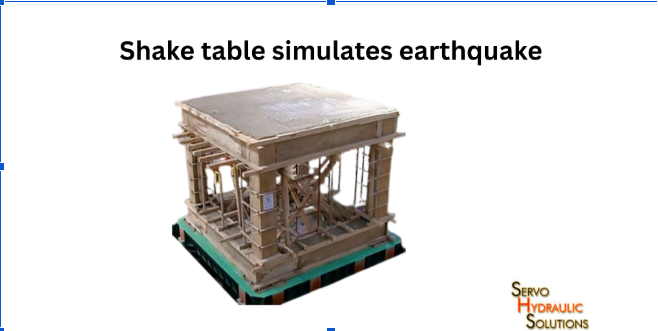
shake tables and earthquake simulates
The difference between shake tables and earthquake simulators
A shake table usually refers to the physical platform that moves the specimen. An earthquake simulator can refer to the complete testing system, including the table, actuators, drive equipment, controller, software, sensors, and safety components.
The terminology varies between suppliers, so buyers should confirm exactly what a quotation includes. A complete installation may also require commissioning, training, foundation work, and ongoing technical support.
Why shake table testing matters for structural safety.
Computer simulations help predict structural behavior, but their results depend on modelling assumptions and input data. Physical testing provides experimental evidence that can be compared with analytical predictions.
Shake table experiments can help researchers study structural movement, connection behavior, damping systems, seismic isolation, and equipment mounting arrangements. They can also reveal unexpected responses that calculations alone may not show.
However, a successful model test does not automatically guarantee the same performance in a full-size structure. Scale effects, material properties, boundary conditions, and test limitations must be considered when interpreting results.
Types of Earthquake Simulation Shake Tables
Shake tables differ in their available motion directions, drive mechanisms, and platform sizes. The right configuration depends on the experiment, not on how advanced the equipment sounds.
Uniaxial shake tables: single-direction motion
A uniaxial shake table moves along one primary axis. It suits basic vibration experiments, classroom demonstrations, and research focused on a single direction of motion.
For example, students can use a small table to observe how changes in a model building’s stiffness affect its vibration. A uniaxial system is often a practical choice when experiments are straightforward, and the budget is limited.
Its main limitation is that it cannot reproduce simultaneous movement along multiple axes.
Biaxial shake tables: two-direction motion
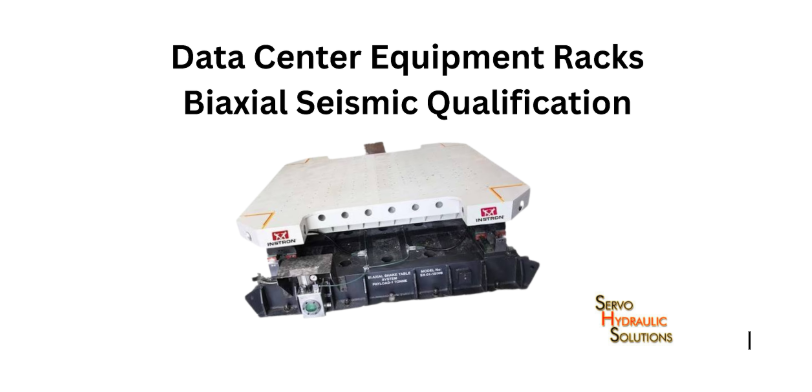
A biaxial shake table typically produces motion along two perpendicular horizontal axes, X and Y, allowing researchers to study combined horizontal excitation rather than testing each direction separately.
Applications include structural model testing, torsional response studies, and selected experiments involving seismic isolation or damping.
Consider an irregularly shaped building model. Its response to motion along one horizontal axis may differ from its response when both horizontal components act together. A biaxial table can help researchers investigate this behavior.
Triaxial shake tables: three-direction motion
A triaxial shake table typically provides translation along X, Y, and Z, allowing two horizontal components and one vertical component to be applied.
Vertical excitation may matter when it affects column forces, connections, foundations, mounted equipment, or structural stability. It can also be necessary when a research protocol requires three-component earthquake input.
Triaxial testing is not essential for every experiment. Researchers should assess whether vertical motion is significant to the test objective and whether the relevant procedure requires it.
Six-degree-of-freedom (6-DOF) shake tables.
A six-degree-of-freedom shake table is designed to control three translations and three rotations:
- Linear movement across the X, Y, and Z axes.
- Rotation about X, Y, and Z, commonly called roll, pitch, and yaw.
This capability is useful when an experiment requires combined translation and rotation. It is more complex than a triaxial system that provides only three translational axes.
It is more complex than a triaxial system that provides only three translational axes, and multi-axis platforms can be engineered using different mechanical layouts such as 6-DOF hexapod and orthogonal shake tables.
Before selecting a 6-DOF system, confirm that the additional motions are genuinely needed for the planned research.
Electromechanical vs. hydraulic vs. servo-hydraulic shake tables
Electromechanical systems use electric motors and mechanical transmission components. Depending on their design, they can suit compact platforms and selected vibration experiments.
Hydraulic systems use pressurized fluid to drive actuators and can be designed for substantial dynamic forces. Servo-hydraulic systems combine hydraulic actuation with feedback control to regulate movement.
| Technology | Main consideration | Potential applications |
| Electromechanical | Motor capacity, transmission, speed, and duty cycle | Compact systems and selected vibration tests |
| Hydraulic | Force, stroke, hydraulic power, and maintenance | Applications requiring hydraulic actuation |
| Servo-hydraulic | Dynamic performance, feedback, and control accuracy | Demanding structural and seismic testing |
No technology is automatically best for every laboratory. Compare actual force, velocity, stroke, frequency, payload, and control performance.
Small-scale vs. large-scale shake tables
Small-scale systems are commonly used for teaching, demonstrations, and compact specimens. Large-scale systems can support heavier or bigger specimens and more demanding experimental programmes.
A scaled model is not simply a smaller version of a full-size structure. Researchers must consider mass, stiffness, material behavior, boundary conditions, and scaling laws.
Choose the platform based on specimen dimensions, mounting requirements, expected motion, and planned future tests—not size alone.
Key Technical Specifications to Understand
A shake table’s specifications determine whether it can reproduce the required motion with the intended specimen installed. Maximum ratings should not be treated as though every performance limit can be achieved simultaneously.
Payload capacity and load limits
Payload includes the specimen and the items moving with it, such as fixtures, brackets, and sensors. Its distribution and centre of gravity also affect system performance.
Check whether the stated payload applies to the required frequency and acceleration range. A table may support a particular mass under static conditions but be unable to produce the required dynamic motion with that load.
Frequency range and its impact on test realism
Frequency, measured in hertz (Hz), describes how many cycles occur each second. Structures and components respond differently across frequencies, especially near their natural frequencies.
Confirm that the system can reproduce the frequencies required for your experiment at the intended payload. A wider frequency range isn’t necessarily better if your research needs only a limited range.
Amplitude (displacement) and stroke length
Displacement describes how far the platform moves, while stroke refers to the actuation system’s available travel. Manufacturers may define these measurements differently, so confirm whether figures represent peak displacement, peak-to-peak displacement, or total actuator travel.
Review displacement alongside velocity and acceleration. The available acceleration may change with frequency, payload, and displacement requirements.
Waveform generation: sine, random, and recorded earthquake data
Different signals support different testing objectives.
| Signal | Typical use |
| Sine wave | Basic vibration and resonance studies |
| Frequency sweep | Investigating resonant behaviour |
| Random vibration | Selected vibration and equipment tests |
| Recorded earthquake time history | Structural response research |
| Artificial accelerogram | Research or qualification tests with defined input characteristics |
| User-defined signal | Specialised experiments |
Recorded earthquake signals may require scaling or processing before use. Confirm which signal formats the controller supports and whether the system can reproduce the target motion accurately under the intended test conditions.
Control systems: closed-loop feedback and digital controllers
The control system translates the target motion into actuator commands and monitors the platform’s response. Closed-loop feedback helps reduce differences between commanded and measured movement.
Review the available control modes, supported waveforms, sensor inputs, motion limits, alarm functions, and data logging capabilities. Software should also fit the laboratory’s existing analysis and reporting workflow.
Data acquisition systems and sensor integration
Data acquisition systems record measurements for later analysis. Depending on the experiment, instrumentation may include accelerometers, displacement sensors, load cells, strain gauges, and hydraulic pressure sensors.
Check the number of channels, sensor ranges, sampling rates, calibration requirements, and timing synchronization. These factors influence the quality and usefulness of the results.
Applications of Earthquake Shake Tables
Structural testing of buildings, bridges, and dams
Researchers use shake tables to investigate how structural models and components respond to simulated earthquakes. Tests may examine displacement, stiffness, damping, connection behavior, and damage development.
For example, researchers can compare two scaled building models with different bracing arrangements under comparable motion inputs. Their measurements can help evaluate design assumptions and validate analytical models.
Seismic qualification of critical equipment
Electrical cabinets, control panels, instruments, and mechanical assemblies may need to remain secure and functional during seismic motion. Shake table tests can evaluate equipment response under specified conditions.
The required test signal, mounting arrangement, and acceptance criteria should be established before choosing the equipment.
Soil-structure interaction and geotechnical studies
Shake table experiments can investigate how soil and structures interact during simulated ground motion. Research may involve soil containers, foundation models, retaining structures, and selected ground-deformation studies.
The soil container and boundary conditions are important because they can affect how the specimen responds. When specifying soil models, liquefaction tests, or centrifuge experiments, dedicated geotechnical shake tables and laminar shear containers help match actuator force, stroke, and lateral soil deformation more closely. The complete experimental arrangement must be designed for the intended research.
Testing seismic isolation and damping systems
Seismic isolation and damping devices are designed to influence structural response during earthquakes. Researchers can use shake tables to compare different configurations and measure acceleration, displacement, or force.
Examples include base isolators, viscous dampers, energy-dissipation devices, and specialized vibration-control components.
Material performance evaluation under seismic stress
Shake tables apply dynamic excitation to structural specimens and assemblies, allowing researchers to examine cracking, deformation, connection behaviour, and changes in stiffness.
For tests that require direct force or displacement loading of a material sample rather than earthquake-like excitation, a different testing machine may be more appropriate.
Educational and research applications
A Civil Engineering Lab Shake Table helps students observe concepts such as resonance, stiffness, damping, and structural response. Universities may use compact systems for demonstrations and more advanced platforms for postgraduate research and experimental model validation, while public exhibits and science centres often rely on a dedicated museum earthquake simulator with preset profiles and visitor-safe guarding.
When choosing Academic Structural Testing Equipment, consider the number of users, expected testing frequency, teaching requirements, research projects, and operator training needs.
Non-structural component and utility testing
Shake tables can also test ceiling assemblies, piping supports, cable trays, equipment mounts, and other non-structural components. Their attachment points and fixtures should be designed to withstand the intended motion.
Suitable guarding, specimen restraint, and operating procedures are essential when testing heavy or potentially hazardous assemblies.
How to Choose the Right Shake Table: Selection Guide
Define your testing objective and target user.
List the experiments the laboratory needs to support. Identify the specimen types, measurements, input signals, motion directions, and any relevant test procedures.
Separate essential capabilities from optional features. This helps keep the specification focused and the budget realistic.
Match table type to your research or industry needs
Choose the number of axes according to the experiment:
- Uniaxial: One-direction testing.
- Biaxial: Two-direction horizontal excitation.
- Triaxial: Three-direction translation, including vertical motion.
- 6-DOF: Three translations and three rotations.
Do not pay for unnecessary complexity, but avoid a configuration that cannot support the research programme.
Evaluate table size, payload, and frequency requirements.
Record each specimen’s dimensions, total mass, mounting arrangement, and centre of gravity. Define the required displacement, velocity, acceleration, and frequency range.
Ask the supplier to confirm that these requirements can be met together under the expected operating conditions.
Assess control system precision and software compatibility.
Confirm that the controller supports the required motion signals, feedback sensors, data logging, and test reporting. Ask whether results can be exported to the laboratory’s analysis tools.
A demonstration using a representative test setup can show system performance more clearly than a feature list alone.
Consider budget, installation, and total cost of ownership.
Include installation, foundation work, electrical services, hydraulic equipment where required, instrumentation, training, maintenance, spare parts, and software support.
A complete cost estimate should distinguish included items from optional extras and work that the laboratory must arrange independently.
Check vendor support, training, and scalability.
Ask about commissioning, operator training, technical documentation, preventive maintenance, spare parts, and service availability.
If future research may require higher payloads, additional sensors, or more complex motion, discuss upgrade options before purchasing. Not every table can be upgraded easily to support additional axes.
Shake Table Selection Criteria: A Comparison Table
Comparing uniaxial, biaxial, and triaxial systems
| Factor | Uniaxial | Biaxial | Triaxial |
|---|---|---|---|
| Translational axes | One | Two | Three |
| Typical motion | Single direction | Two horizontal directions | Two horizontal and one vertical |
| Common application | Basic experiments | Multi-directional horizontal testing | Three-component seismic testing |
| Relative complexity | Generally lower | Moderate to high | Often higher |
| Main limitation | Single-axis motion | No inherent vertical motion | No inherent full rotational control |
Comparing drive technologies
| Factor | Electromechanical | Hydraulic | Servo-hydraulic |
|---|---|---|---|
| Drive | Electric motor | Hydraulic actuation | Hydraulic actuation with servo feedback |
| Key checks | Motor capacity and transmission | Force, stroke, and hydraulic capacity | Dynamic performance and control accuracy |
| Maintenance focus | Drive and mechanical components | Fluid, filters, seals, and hoses | Hydraulic components, sensors, and control system |
Matching specifications to your testing goals
| Testing goal | Main specifications |
|---|---|
| Student demonstrations | Platform size, simple control, and safety |
| Structural model testing | Payload, motion range, frequency, and instrumentation |
| Multi-axis research | Axis configuration and simultaneous motion performance |
| Equipment qualification | Required input records, fixtures, and acceptance criteria |
| Advanced research | Control precision, actuator capacity, DAQ, and scalability |
Common Mistakes When Selecting a Shake Table
Underestimating payload or frequency requirements
A platform’s static payload rating does not guarantee that it can reproduce the required acceleration or frequency under load. Provide the supplier with realistic specimen details and request performance data for the intended test conditions.
Ignoring facility space, power, and foundation needs
Installation may require structural support, electrical capacity, hydraulic equipment, maintenance access, and safety barriers. Review these requirements before ordering the system.
Overlooking maintenance and long-term operating costs
Maintenance, consumables, calibration, spare parts, software support, and downtime can affect the total cost of ownership. Ask for a maintenance schedule and a clear explanation of post-installation support.
Choosing a system without considering future scalability
Future projects may require different specimens, additional instrumentation, or more complex motion. If a laboratory plans to start with single-axis testing and add a second horizontal axis later, evaluating phased uniaxial-to-biaxial shake table expansion early helps verify foundation loads, hydraulic capacity, and controller channels before installation. Discuss realistic expansion plans early, while recognizing that some upgrades may require substantial redesign.
Maintenance and Safety Best Practices
Routine inspection and calibration schedules
Follow the manufacturer’s maintenance recommendations and document inspections, repairs, and calibration. Check fixtures, fasteners, sensors, cables, mechanical components, and safety devices at the intervals appropriate to the equipment and its use.
Calibration verifies measurement performance, while functional checks confirm that equipment operates as intended. Both may be necessary.
Hydraulic system maintenance and leak prevention
For hydraulic systems, follow approved procedures for fluid condition, filter replacement, hoses, seals, fittings, and operating temperatures. Never use your hands to locate a pressurized hydraulic leak. Isolate the equipment and have trained personnel follow the approved maintenance procedure.
Safety interlocks and emergency shutdown procedures
Before each test, check specimen restraint, fixtures, operating limits, exclusion zones, emergency stops, and communication procedures. Never bypass safety interlocks to complete a test.
Operator training and documentation requirements
Operators should understand motion control, waveform preparation, specimen installation, data recording, emergency procedures, and safe shutdown. Maintain accessible test plans, risk assessments, operating instructions, and maintenance records.
FAQs: Earthquake Simulation Shake Tables
What is a shake table and how does it work?
A shake table moves a specimen according to a controlled motion signal. Actuators produce the movement, a controller regulates it, and sensors record the platform and specimen response.
What is the difference between uniaxial, biaxial, and triaxial shake tables?
Uniaxial tables provide one-direction translation, biaxial tables typically provide two horizontal directions, and triaxial tables provide translation along three axes, including vertical motion.
How much does an earthquake shake table cost?
The cost depends on platform size, payload, number of axes, actuator technology, control system, instrumentation, installation, and support. Request a quotation based on your actual test requirements.
Can small labs or universities afford a shake table?
Yes. Compact systems can support teaching and selected research experiments. Universities should compare the initial cost with installation, training, maintenance, and planned future use.
What specifications should I check before buying a shake table?
Check motion axes, payload, platform size, displacement, velocity, acceleration, frequency range, controller capabilities, instrumentation, safety, installation, and technical support.
Can shake tables simulate real earthquake data?
Many systems can reproduce recorded or processed earthquake time histories when the controller and actuators support the required motion. Verify signal compatibility and tracking performance with the intended payload.
What is a 6-DOF shake table and when is it needed?
A 6-DOF table controls three translations and three rotations. It is appropriate when the experiment requires combined translational and rotational motion.
How often should a shake table be maintained or calibrated?
The schedule depends on manufacturer guidance, equipment use, test intensity, and sensor requirements. Follow the specified intervals and arrange additional checks after repairs or abnormal operation.
Conclusion: Selecting the Right Earthquake Simulation Shake Table
The right Earthquake Simulation Shake Table must reproduce the required motion, support the specimen, and meet the laboratory’s operational and safety needs. Uniaxial systems may suit teaching and basic tests, while biaxial, triaxial, and 6-DOF systems support increasingly specialized motion requirements.
Before purchasing, compare payload, displacement, velocity, acceleration, frequency, control performance, instrumentation, installation, maintenance, and future scalability. A clear technical specification will help you select suitable Seismic Testing Equipment for Universities and other structural research applications.
Explore custom shake table solutions.
When standard platforms cannot handle unusual payloads, high overturning moments, or specialized multi-axis test envelopes, a custom servo-hydraulic shaker table can be engineered around your exact requirements. Servo Hydraulic Solutions can be contacted to discuss requirements for specialized testing systems.
Contact the supplier to discuss your research objectives, specimen size, motion requirements, laboratory space, and expected operating costs. Request a technical specification and lifecycle cost estimate before finalizing your system.
Ready to Design Your Custom Earthquake Simulation Shake Table?
Whether you need a compact uniaxial platform for teaching or an advanced multi-axis servo-hydraulic system for structural research, our engineering team is ready to help you configure the right testing equipment.